

Gnosis
Part 4 of Valentine's Logos

(This is part 4 of Valentine’s Logos, originally written in 2024. If I had to point at a single idea at the center of my methods and strategies, it would be the one spelled out here.
This part is probably readable on its own. What you’ll be missing is what problem gnosis is solving (from part 1), why it’s a powerful solution (from part 3), and what some of the terms mean (e.g. “Original Spin” and “selfing process” get defined in earlier parts). But I think the main thrust, and most of the examples and points, stand on their own just fine.)
At this point I have enough tools to start clearly naming a fiery passion I have.
I’m going to start by giving some historical context.
After Pythagoras died, there were two main sects that survived him. One, “the listeners”, went on to worship his exact words and phrases as instructions on how to live a good life. The other, known as “the learned ones”, recognized Pythagoras’s main point to be the development of a deep personal relationship with truth. That latter group went on to create new insights, including advances in geometry and arithmetic. Their methods permeated Plato’s context and went on to become a key part of our Western philosophical tradition.
The Greek word for these “learned ones” was “mathematikoi”. From which we get our word “mathematics”.
It’s important to understand that their subject of study wasn’t what we’d call “math” today. It wasn’t about learning methods or theorems. The point of these practices was to align the person with something profound — what we might call the True, the Good, and the Beautiful. Remember Plato’s Allegory of the Cave: that wasn’t just a treatise on the importance of memorizing a bunch of geometry facts!
The Greek word for “truth” at that time was “aletheia”, a reference to the River Lethe which would make the dead forget their earthly lives. “Lethe-ia” refers to forgetting, so “a-lethe-ia” is un-forgetting. Plato argued that this is what’s going on with really getting a proof: sometimes when you meditate on a proof deeply enough, it goes from “Yep, the logic checks out, I trust this is true” to “Oh! I get it!” Plato suggested that this is due to the soul having come from the Absolute Truth. So when a mind is sufficiently tuned to truth, the soul recognizes and remembers (un-forgets) it.
The subject that the mathematikoi studied was called “mathema”, meaning “that which is learned” or “that which one comes to know”. A reasonable translation of “mathema” into Latin is “scientia”, from which we get our word “science”.
That’s not a coincidence. The founders of the scientific revolution often knew both Greek and Latin, but Latin was the common language used among intellectuals at the time. Hence Newton writing Principia Mathematica in Latin for instance.1
When I’m talking about the True Art of mathema, I mean the thread that awakened the Western mind and created Plato’s Academy. I mean the thing that sparked the Renaissance when reintroduced in the wake of the Black Death. I mean the soul-fire that lit the scientific revolution in the social ruins of the Church after the Reformation. To the extent that there’s life from the Age of Enlightenment, it comes from this thread.
It is an absolute fucking travesty that we collectively lost the spiritual dimension of mathema. That the formalists won the paradigm wars at the turn of the 20th century. That religion was reframed as a backwards idea we had simply not yet grown out of. That we came to consider the view of the body as a machine as correct instead of as merely a mental tool for solving certain problems. That wisdom was forgotten and ignored in pursuit of dead knowledge.
The ancient Greeks mostly didn’t use the word “gnosis” for the kind of sacred knowing that mathema trained. That word came much later, with the Gnostics. The Gnostics held that the world was created by an evil god, the “demiurge”, who keeps us trapped here in confusion and pain via deception. The demiurge twists all spiritual teachings to keep us disoriented and following false paths. The only way out is to cultivate knowing that is incorruptible, that not even the demiurge could confuse us about. That knowing was called “gnosis”.
I don’t believe in a demiurge, and a lot of Gnostic teachings are quite dark and very life-disavowing in ways I find highly distasteful. But I think they were onto something. The memetic wilderness does keep producing deceptions and twisting spiritual teachings in just this kind of way. It has an emergent intelligence. And the evolutionary incentives are not systematically toward sanity and kindness for humanity. In many cases the things done in the name of love are downright evil.
The reason I care about gnosis is that it shines an incorruptible light on the memetic darkness. It shifts the evolutionary landscape to bias toward sanity and kindness in human terms.
I don’t think the Gnostics or the Pythagoreans — or anyone, really — had a full picture of what deserves to be called “gnosis”. Otherwise we wouldn’t be in our modern predicament. I doubt I have a full picture just yet either.
But it seems within reach, and the effort to reach for it is self-correcting. We’re looking for a solution to a specific memetic problem. History, spirituality, and the mathematical sciences all have hints about a possible solution. The meta-meme gives us additional context and insight that wasn’t there before in the past methods. As long as we don’t get distracted or confused about the point of what we’re doing, our aim can act as a guiding light through whatever memetic distortions try to show up along the way.
So as I spell out my current understanding of gnosis, please don’t take this as an argument for you to agree or disagree with. Take it as an invitation to look somewhere and see whatever you see. I’m extremely clear in myself about some of this, and I’ll try to offer up that clarity for you to examine. But it doesn’t matter if you agree with me. What matters is that you have a way of recognizing the truth. Hopefully we’ll come to agree as a matter of us both recognizing the same thing and learning to sync up our ways of talking about it.
Unalienable knowing
We have examples of understanding that not even a demiurge could confuse us about.
I mentioned evolution in this light before. There’s a certain “click” that can happen (an aletheia-ing) where the basic idea of evolution is obviously inviolate. That even the Christian God is not strong enough to defy: even if Young Earth creationism were totally correct, evolution would necessarily have started at the moment of creation, and thereafter God would have to intervene at the molecular level time and time again to prevent things from evolving.
(And quite tellingly, this would mean we could empirically test whether such a God is real!)
That confidence doesn’t come from the tons of evidence in the fossil record, or the widespread agreement of scientists. It’s much deeper than that.
In this context I sometimes refer to deep laws. These are tautologies that human minds often nonetheless treat as false. Evolution is one of these: it’s inviolate not because there’s something enforcing some pattern, but because it’s a necessary consequence of patterns surviving through time. It’s inherent in what things like “pattern” and “time” mean.
The second law of thermodynamics is another deep law. I love this quote from Arthur Eddington as a way of highlighting what (I think) gnosis feels & sounds like here:
“The law that entropy always increases, holds, I think, the supreme position among the laws of Nature. If someone points out to you that your pet theory of the universe is in disagreement with Maxwell’s equations — then so much the worse for Maxwell’s equations. If it is found to be contradicted by observation — well, these experimentalists do bungle things sometimes. But if your theory is found to be against the second law of thermodynamics I can give you no hope; there is nothing for it but to collapse in deepest humiliation.”
The point isn’t to believe it, though! That’s not gnosis of entropy. Gnosis of entropy arises from seeing its tautological nature — that there’s literally no other way reality could possibly be.
Gnosis of interface
“But wait!” I hear some psychonauts exclaiming. “Do you really get to know even that? You could still be confused! Reality is pretty mysterious after all.”
I’m thinking for instance of my experiences on Ayahuasca and Bufo (5-MeO-DMT). It’s pretty laughable in the wake of those encounters to imagine that reality could be logically constrained.
But here’s what I can know, even there: I can know how things seem to me.
In my Less Wrong essay “Gears in understanding”, I emphasized how I was talking about properties of maps that have nothing to do with how well or poorly they correspond to the territory. For instance, the labels on a roadmap might make it ambiguous which road is being named. That has nothing to do with whether or not the map is accurate. I can tell whether or not I can understand the map’s claims. And there’s a way that what sense I make of the map’s claims is unarguable: you might disagree with how I’m reading the map, but I’d have to get extremely confused to agree that I’m not reading the map the way I am.
Likewise, when I look outside my window, I see San Francisco. Or at least I think so! I’m actually seeing a mental overlay that labels my experience “San Francisco”. My mind could get lost in recursion here: isn’t it an overlay telling me there’s an overlay saying it’s SF? But there’s something simpler and clearer and more fundamental: I can tell that my impression is that I see the city. I might be confused about the context — maybe I’m dreaming, or on a psychedelic trip I forgot I’m on, or in a hallucination while I’m actually dying, or whatever — but I cannot be confused about the fact that my experience appears to me the way it appears to me.
Likewise, I find the sentiment “I know that I don’t know” helpful. No matter how confused or doubtful I get, I can tell something — that I’m confused, that I doubt, that I lack clarity, etc. I can have unassailable clarity about that.
Infallibility
The real point of mathematics, in my opinion, is to recognize and refine this kind of unalienable knowing. It’s the art of cultivating gnosis. It grants a kind of clarity that lets you say “No, actually, one plus one really is two. That’s just true. If you disagree with the truth, you’re wrong. That has nothing to do with me. I just happen to know the truth, which allows it to speak through me right now.”
That said, it’s possible for someone to bring up “counterexamples”. For instance: a cup of water plus a cup of salt doesn’t make two cups of saltwater. So does this violate 1+1=2?
Lots of people who don’t understand gnosis try to answer that “1+1=2” is an “abstract truth” and thus the saltwater thing doesn’t touch it. But I think they’re confused. That “abstract truth” totally applies to saying that a cup of water plus a cup of vinegar gives two cups of liquid. This idea that math is made of “abstractions” as though those ideas are part of some Platonic Ideal realm that only magically sometimes overlaps with our world… this is a cope. It comes from an ongoing confusion about what math is.
So what goes wrong with saltwater? Well, obviously, “1+1=2” doesn’t apply here for some reason. Why not? What hidden assumption gets violated?
(You’ll get more out of this if you pause reading and honestly try to figure it out.)
Hint: If we’d combined a pound of water and a pound of salt, we absolutely would have gotten two pounds of saltwater. What’s different about pounds vs. cups here?
The answer is…
…when we say “1+1=2”, we assume that the process of addition doesn’t change the quantities that the “1”s refer to. But the volume of salt changes when mixed with water (in a way that mass, and thus weight, doesn’t).
Once you see it, it probably clicks. That’s obviously what’s going on here. The example clarifies something about what we meant by “1+1=2”. It turns out that our understanding of addition relies on object permanence. If “adding” destroys or creates more stuff, of course the end result won’t match the equation!
But just as importantly, your trust in 1+1=2 probably wasn’t itself challenged by the “counterexample” even though you probably didn’t know why not. I think this is behind people’s attempts to defend it by claiming it’s an “abstract truth”: they know it’s true, they just don’t know how to relate it to the saltwater situation, so they try to make up justifications.
I claim that this quality of knowing deserves to be called “gnosis”. Most folk have gnosis that 1+1=2. That doesn’t mean that our mental interpretation of what we gnostically know won’t change! But if we’re clear with ourselves that we are in fact tuning into truth, then “counterexamples” serve to prompt our minds to clarify what it is that we know — instead of making us question whether we know anything at all!
Confidence & humility
I often reference “100% confidence and 100% humility” as seemingly paradoxical properties of gnosis. As opposed to it being some balance of the two, or some closed-minded certainty. This is what I mean: you’re unshakably clear and sure that you know something, and that your current way of thinking & naming it is at least pointing at the thing you know, but your mind’s best handles for it could turn out to be meaningfully or even completely broken with respect to some application of the knowledge that’s relevant to you. Your articulation can be disproven, but not your knowing. The latter just gets clarified.
A historical math example: the field of topology got its start from attempts to understand why the Euler characteristic of all polyhedra seemed to be 2. Mathematicians produced a number of proofs that it’s always 2, some of which are quite elegant and compelling.2 And then folk started finding counterexamples. Much like with the saltwater situation, it turned out that mathematicians were making assumptions they weren’t aware of about what a polyhedron was. There were debates across decades about whether we should redefine what counted as a polyhedron or if we should count Euler’s observation as a fluke. This finally got resolved when Poincaré suggested flipping the logic: given a shape’s Euler characteristic, what can we know about it? It then turns out that all polyhedra with characteristic 2 are spherelike, rather than (say) doughnut-like.
One could be forgiven for thinking that the proofs were just wrong. But they weren’t. They were demonstrations of some kind of truth. Mathematicians were just wrong about what had been proven, in a way that turned out to matter for the topic they were examining.3
The same thing applies to the deep law of efficiency. People bicker about the efficient market hypothesis (EMH), often citing examples of markets that aren’t efficient. But the EMH is to the deep law of efficiency as thermodynamic equilibrium is to entropy. The logical arguments for EMH give parameters for understanding how the inefficiencies must arise, much like proofs that the Euler characteristic is always 2 help us see what must be different about a shape for it to have a different characteristic.
For instance, when Bitcoin first appeared, only a few people saw its potential and bought a bunch. A lot of those people became “crypto millionaires”. EMH would imply that they were purely lucky. But my own experience was that even though I mostly believed what the people around me were saying about Bitcoin’s potential, I literally could not buy any. I couldn’t figure out how. I just didn’t have others’ tech savvy to do it. And quite a few people just thought it sounded weird and suspicious. Those technological and social frictions seem sufficient to me to explain the inefficiency: everyone could have the same info about Bitcoin’s positive expected value, and the market would not have had the ability to reflect that knowledge in Bitcoin’s price yet.
So it would be ludicrous to assert that the EMH is just always true — but it would be something like self-gaslighting to pretend that you don’t know something from the reasoning. Something is inviolate, and you can tell! It just turns out that the initial description was meaningfully wrong.
And even here, it might turn out that the deep law of efficiency still falls short! It might make assumptions that sometimes don’t apply to things we care about.
But even so, it’s not just a hands-in-the-air “I guess we can’t know anything for sure.” We absolutely know something. It’s just critically important that we not grip to our current mental interpretation of what that something is.
Tracing the proof
I claim that the right use of proof, in the context of math (as normally understood), is to give a formula for developing gnosis of something.
I’ll generalize this from math in a moment. But as is often the case, math has some pretty tidy examples that I think make the generalization easier to understand.
Normally, proofs are viewed as something like a verification of a claim’s truth, or at least that the claim follows from premises. But I think this is nuts. You can’t know all the premises you’re operating under: that’s one of the major lessons from the history of the Euler characteristic, as one of a bazillion examples.
I think it’s far more sane and practical to view a proof as playing a similar role as kata does in martial arts. Katas (literally “forms”) are prescribed movement sequences you train over and over again. The idea is that you want these sequences available and mastered when you need them, instead of having to improvise in the middle of sparring every time.
For instance, here’s a visual proof that the internal angles of a triangle sum to 180º:
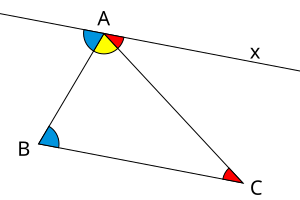
The point here is to offer a seed of insight. I could explain the image, but the lion’s share of the value comes from sort of meditating on it and seeing for yourself why the conclusion must be true.
In the course of doing so you might change how parts of it are expressed to make it fit your mind better. For instance, I say “180º” because that’s standard, but it’s not how I think of it. I think of it as “They sum up to a straight line.” This kind of thing naturally happens as you make the “kata” yours. It often changes even what you think is being claimed. (For instance, even though it’s not stated, the above image makes sense only if the line x is parallel to the line segment BC.)
There’s a kind of “click”, an aletheia-ing, that you’re looking for in this meditation. The point isn’t that you get to know this random fact. The fact mostly doesn’t matter to most people. The point is that the practice of tracing the reasoning until it’s truly yours shows you how to turn a claim into your own gnosis — and how to correct (your understanding of) the claim so that you can tell what is true, and why it must be true.
Once you have that “click”, you can apply the reasoning process you used to get it each time you need it. You know two of the angles of a triangle and you want to know the third? Well, you can sketch the above drawing on top of your specific triangle, and repeat your now more familiar (and probably more streamlined) path of reasoning, and it becomes incredibly obvious that the angle you’re looking for must be 180º minus the sum of the two known ones. Not because you applied some memorized formula, and not from just using the above theorem’s conclusion, but because reality can’t move any other way, and you know it. You directly see it.
By way of contrast, it’s pretty common in geometry classes to show students some proof like this one and then have them use the conclusion to solve problems (like finding the unknown angle). And maybe separately test whether they’ve memorized the proof.
But this is bonkers. It separates the conclusion from the reasoning. It’s practicing deference to authority — practically the opposite of gnosis!
I saw the result of this gnosis-defiance quite a lot as a math teacher. Students would get confused if a triangle were drawn on a sphere: their knowledge about triangles and 180º was a floating fact rather than something that critically depended on their sense of the parallel postulate. Likewise, I’d see students applying the Pythagorean theorem to non-right triangles, because that’s just the algorithm they’d habitually trained for finding the unknown length on a triangle. The need for the triangle to have a right angle just wasn’t relevant to their problem-solving efforts. They were using a dead conclusion instead of a living perception.
To call back to deep laws, this is a case where they were extending a tautology to a context it didn’t apply in. Math theorems are demonstrations of tautologies: “The sum of the internal angles of a triangle is 180º” is just as redundant as “A triangle has three sides” to a gnostically well-trained mind. The point of a proof is to help you see the tautology as such. The point of tracing the proof is to integrate the perception of the tautology into your sense of what reality even is.
So, that’s in math.
A non-math example is Malcolm Ocean’s Non-Naïve Trust Dance (NNTD). NNTD is a deep law — which is to say, a relevant tautology. He often states it as “You can’t trust what you can’t trust.” (This is akin to evolution as the tautology “Patterns that are better at spreading will spread more.”) The practice of applying NNTD is a matter of tracing proofs of NNTD in cases where our minds don’t automatically perceive it and might treat it as false or irrelevant.
A violation of NNTD might sound like “You should trust me.” There’s a clear perception of how trust works that makes this statement ludicrous. No, it’s not the case that the person should trust the speaker. That’s incoherent. Tracing the proof of NNTD here makes the incoherence necessary, and adds texture and detail to what I even mean by “incoherent”.
(Bear in mind that I haven’t really outlined or even hinted at the proof. I’ve done the equivalent of stating the theorem’s conclusion. A trailhead to a proof might be: if the listener doesn’t trust the speaker, what exactly is the speaker implying the listener should do with their distrust? Assuming it’s possible to do, how would that action relate to the cause of the distrust?)
As with “normal” math, though, the goal here isn’t that you feel the plausibility of what I’m pointing at here with NNTD. It’s that you register a claim, and meditate on it, and come to integrate an unalienable knowing — and possibly say it differently, and maybe even correct some of what I’ve said!
As a foreshadowing of the self-reference check for gnosis below: this reasoning about proof-tracing applies to itself. The point isn’t to make you feel moved by my vision of tracing proofs, or of gnosis in general, and therefore you need to decide how much you agree or disagree with me. It’s more like, I’m sketching a diagram that traces several proofs in my perception. I’m hoping you can use these as meditative objects to claim your own unalienable knowing about these topics. Then the ideas we’re comparing are vivid and clear. Gnosis then permeates our shared understandings, which puts a massive evolutionary pressure on the memes that thrive between us.
Plausibility vs. necessity
I find it key to distinguish between arguments of plausibility versus necessity. Gnosis is a clear perception of what’s necessary, carried with a confident-yet-humble mental guess about the best currently relevant articulation of that necessity.
The difference between a proof and a good old argument is that the proof is making a case for necessity. It’s not just that things could be a certain way, or that they probably are, but that it would be deeply incoherent for them to be any other way.
The claim about the internal angles of a triangle is that there’s no room for them to sum to anything but a straight line. Not that they just often do, or that it’s pretty reliable. It’s in the definition of what a triangle even is!
The “counterexample” of a triangle drawn on the surface of the Earth, with one point at the north pole and the other two on the equator, is very much like the earlier saltwater “counterexample” to 1+1=2. It offers clarity about what is necessary, and when. But it doesn’t refute the necessity itself.
Similarly, evolution is necessary. That’s key to what makes it a deep law. We could maybe imagine a world where gravity is slightly stronger or weaker, or where light really does travel through luminiferous aether and has different speeds to different observers. But it’s deeply incoherent to imagine a world without evolution, or where evolution works slightly differently.
And to the extent that you haven’t seen that, you haven’t seen the deep law!
The main thrust of what I’ve been trying to share in this document is a big necessity argument. A proof. I’m trying to offer a sketch of a kind of meta deep law. It’s about how deep laws are seen, and how that relates to the (deep) law of memetic evolution. How the (deep) law of ecosystem efficiency constrains what kinds of memetic actions and efforts are even possible, and what results they necessarily must have.
And at the same time, some of what I’ve been sharing is merely plausible. The details I gave about minds’ functions are educated guesses based on observation. They derive from gnosis of mind’s mechanistic nature: there must be mechanisms like these. But much like the deep law of evolution doesn’t necessitate that we’re closely related to chimpanzees, the deep law of mental cause-and-effect doesn’t demand that we have a selfing process.
However, given the selfing process as described, the glitchiness of the structure of Original Spin is guaranteed. I don’t yet have either a proof or a counterexample to the conjecture that self-tooling is always inefficient (in the sense of there always being a better problem-solving method), but the specific application of self-tooling that’s Original Spin is reliably degenerate. It’s not something a mind would ever adopt without another mind basically requiring it to.
I keep saying I’m doing math on the mind, instead of on numbers or shapes. This is what I mean. When you start taking gnosis really seriously, and you observe the mind, you can use gnosis to organize the mind and actually goddamn know some things about how it works in ways that matter.
Then attempts to engineer the mind aren’t just ephemeral wishes in a soup of theory. They become empirically testable, observable, and a source of real problem-solving for issues that root in the psyche.
…such as the global puzzle of getting memetics right.
Social anti-gnosis
I think there’s also such a thing as anti-gnosis. Not just the absence of gnosis, but a kind of mental engine or program that actively and strategically blocks gnosis cultivation within the mind running these patterns.
I’d like to sketch a plausible (as opposed to necessary) model here of the main way I see this happening. Like much of what I’ve said in this document, it derives from the mental machinery I’ve laid out. But given that machinery, there are some necessary consequences, and I do think we in fact observe those very consequences in practice.
Minds solve problems. That’s all they ever do. All mental activity is the result of taking some goal or intention from the user and then working on finding ways to accomplish it.
But some problems interact with the ways in which the mind tries to solve them. This happens a lot (and maybe exclusively) in social contexts. If I need others to like me, but I also expect that trying to get others to like me will make them like me less, then how do I get them to like me? How do I even ask the question without thwarting the goal?
This kind of puzzle creates self-reference loops of exactly the type that minds have trouble with. Giving a mind a problem like this is basically guaranteed to create inefficiencies, the way Original Spin is an inefficiency.
This is a meta-problem I used to see a lot in math education. Students often (correctly) recognize math class as giving them a social problem. Their goal is to navigate social forces that require them to “do well” in the subject. So they try to figure out what kinds of answers the teacher wants to hear, and what kinds of excuses can let them avoid penalties and get higher grades, etc. Sometimes this involves developing mental tools that let them actually solve math problems — but only if that’s the easiest way to solve the social problem! Lots of teachers complain that students “aren’t thinking” about the math, but that’s because many of them don’t care about the math. They care about the social force the teacher wields. So that’s what they’re thinking about!
But if they get in trouble for explicitly thinking about that, then naturally they’ll try to hide their problem-solving effort from the adults. And sometimes the strategy they converge on is to hide that problem-solving effort from themselves. (“I’m really trying! I swear! I’m just bad at math!”)4
It’s helpful to remember that minds don’t inherently care about truth-tracking. Truth-tracking is a strategy for solving problems. If a mind notices a better strategy than truth-tracking for solving a given problem, it’ll employ that better strategy instead.
I think this is the core issue that makes trauma possible. Children survive by solving the social problem of getting along with their caretakers. Their caretakers also have perception abilities that can feel to the children like mind-reading. So as an example, if a toddler’s mom gets mad at the kid and insists he’s “being bad”, and gets more angry if he doesn’t show sincere remorse for “being bad”… then the easiest way for the child to solve the social problem might be to don Original Spin. Which is to say, to actually think of himself as having “been bad” and misinterpret his fear of loss of mother’s love as pain about “being bad”.
If he trusted he could handle his mother’s anger, he wouldn’t need to gaslight himself this way. I think this is the basic logic behind most “trauma processing”. Adults can in principle handle their mom being upset or cold or whatever toward them, because their survival doesn’t depend on her approval anymore. If that fact feels real to them and is brought into contact with their fear, it becomes safe to recognize the Spun-up strategy because the adult now has a better strategy on hand.
But this doesn’t work if there’s still a real social problem — or more precisely, if the person with an anti-gnostic strategy can’t trust there isn’t still a real social problem.
For instance, I’ve seen quite a few mothers in abusive relationships who would go to great lengths to justify her husband’s behavior. Often for years. It would be an impenetrable wall of rationalization… until she got enough financial and social resources that she trusted she could take care of herself and her children without him. Only at that point was she able to risk admitting the problem to herself and risk him picking up on her changed view of him.
The issue being, humans are something like telepathic. If she admitted to herself that he’s abusive, she’s likely to change subtle stuff like her body language and vocal tone, even if she tries not to. Those are things he can pick up on. So if she in fact can’t handle the consequences of him reacting to her view of him, she needs to control her view of him — even if doing so amounts to gaslighting herself.
Sorting out anti-gnosis looks to me like a prerequisite for developing gnosis. The mother in the above situation doesn’t need skill with proof-tracing (and in fact she might not be able to develop such skill if she can tell it would clear her mind!); she needs help, and money. Or some other way of handling her situation — all while denying she has a situation that needs handling!
I don’t think anyone has a general solution to anti-gnosis. In a culture where people deeply, in their bones and sinews, respected one another’s sovereignty and clarity… then yes, I think we could be free of it. But that’s not the culture we’re in.
And I get sort of angry with people who insist that their Favorite Theory™ just solves this. Lately it’s “getting a regulated nervous system”. That’s super valuable. It might be the best we can do for now. But claiming it’s a complete solution is distracting. It’s ignoring the nature of real-world power. It alienates gnosis by masquerading as certainty instead of as plausibility. The mother up above often can’t learn enough nervous system regulation tools to keep her children safer than she expects they would be by her continuing to BS herself.
I think it’s important to recognize this as an open problem. We have a few partial solutions, but nothing robust, short of a deep memetic transformation of the cultures we’re embedded in.
…at least as far as I know. I would very much like to discover I’m wrong here.
Some gnostic observations
Remember that at the very beginning, I referenced how the aim is to make what truly matters the organizing principle of the mind.
I haven’t quite gotten there yet. We’re close. But I need to point at a few specific topics first now that we have the context of gnosis and anti-gnosis.
The spread of topics might seem a bit random. But my impression is that they are in fact key. I hope to make that clear later on.
Problems before solutions
Anti-gnosis often comes with fixation on solutions. Not solving problems, but solving them in a specific way. And then using some kind of force to push aside the reasons why those solutions don’t work.
This is sort of like blindly believing “away” is a place you can actually throw things. Because reality disagrees, the attitude builds up metaphorical (or literal!) garbage that the minds implementing the strategy will tend to ignore. If their filtering mechanisms are strong enough, then eventually Death will educate them in ways they find surprising and confusing.
I once described this problem as “adaptive entropy”. It’s an attempt to apply adaptive intelligence in a way that makes that intelligence dumber. Adaptive entropy tends to show up as problems that resist being solved — not just that they’re difficult (like the Riemann hypothesis), but that use attempts to solve them to make themselves worse (like culture wars).
The core issue here is the fixation on a conclusion. A generalization of rationalization.
For the most part, mind-like systems work best if the focus is instead on the problem. On clearly articulating it, holding off on proposing solutions, and using proposed solutions to better understand the problem rather than to just make the problem go away.
When you name an actually good solution that in fact accounts for all the variables, it practically implements itself. No force is needed. And no adaptive entropy gets incurred.
This pattern shows up in math education. Most math classes get the order of instruction backwards: they describe some method or tool and then give students example problems and homework to practice those methods. This then requires the teacher to specify the order of mathematical tools they’ll “cover” and find some way to motivate the students to learn them. The default answer is to apply social force (and thus induce anti-gnosis, which often results in math trauma).
It works far better to let students’ interests lead, notice places where there are mathematical problems that are already relevant to the students, point those problems out, and let them flounder without giving them the tools to solve those problems. Quite often the students will invent methods that are logically equivalent to known mathematical ones. But even if they don’t, after they’ve struggled for a while with the problem they’ll be able to recognize an offered solution method as vividly relevant to them. The teacher becomes helpful support for students’ interests instead of an authority jamming prescribed ideas into students’ heads against their will.
This pattern is close to universal. In practice, anti-gnosis amounts to strategic confusion about what problem you’re solving and/or whether something counts as a solution. Just getting clear on what problem is even being solved, and how you could tell if you were making progress, makes a huge difference!
It’s worth bearing in mind that lots of memes rely on anti-gnosis to survive. Meaning that moves that create clarity and offer superior strategies will often encounter intelligent resistance. One example I bumped into back in 2020 was an otherwise very brilliant fellow asserting that Trump supporters were all idiots who weren’t worth listening to and should be politically overpowered. I tried to point out that even if that person were right about them, his strategy for dealing with them was worse than one based on learning to listen to and understand their perspective. He spat venom back at me saying that there’s no point, they’re stupid, he’d tried and there’s no getting through to them, they deserve his hatred and dismissal, etc.
(I swear, memetic possession almost literally looks like cordyceps of the mind to me now. A zombie apocalypse indeed!)
So, I think it’s worth keeping an eye on places where we’re inclined to cling to a solution, instead of using that proposed solution to better understand the problem.
This idea of “problems first” doesn’t survive a self-reference check unless we see how adaptive entropy points at a deep law. Which is to say, gnosis of adaptive entropy clarifies what this “problems first” approach is even trying to say, and how it applies to itself.
This “problems first” guideline, by the way, suggests that it’s helpful to view ideas as having no inherent value. Ideas are tools for solving problems. Sometimes that “problem” is just that you’re really curious about how something works! But getting lost in absorbing “true theories” just because they’re true is almost certainly a confusion, and is probably downstream of anti-gnosis.
Stillness, prayer, & listening
A defining characteristic of gnosis is the self-validating “I can tell for myself” quality.
That cannot come from thought. It can’t originate in the mind at all! One way to see that is by watching the 3-step process for using the mind that I outlined in part 2:
I push an intention to my mind.
My mind does some black-box process and generates a response.
I consider the output and decide if it satisfies me.
How do I know how to do steps 1 and 3? It can’t come from the mind, because this process is how I’d prompt the mind to tell me how to use it. The knowing must be prior to thought.
And yet, I can have a mental reflection of this process. Hence my ability to talk about it here!
The problem is that when the mind governs the process of understanding gnosis, or understanding itself, it runs into self-reference paradoxes. And it will usually try to resolve those paradoxes with recursion and/or filtering.
In practice this means that the mind will lose track of the difference between (a) its models of gnosis and (b) gnosis itself.
Taking the mind as object helps a great deal with this. From what vantage point are you viewing the three steps I named above? It’s not something the mind can do since it involves observing the whole mind, which would involve mentally impossible self-reference. And when the mind tries anyway (with its recursion and awareness-collapsing strategies), it’ll tend to cause a loss of body awareness. That shows up in shifts in language where “the body” (usually as a mental icon) gets put in third person because identity moves to the currently active part of mind, which said part cannot see.
The actual vantage point beyond the mind that can observe all this is very simple. It’s vast, vividly present, and quite capable of what the mind would tag as self-reference.
Because it’s beyond (or prior to) the mind, it’s a particular kind of silent. Vividly alive, but utterly still.
I’m describing this in third person to make noticing the logic easy for the mind. But it’s vividly first-person. I’m not sure how to convey this point without shifting identity to the still silent “witness”. But notice that when I talk about “the still silent ‘witness’”, the vantage point has to be outside whatever is being observed. I’m gesturing instead at where you’re observing from. 🫵
Minds have a very hard time stabilizing on this place (shifting back to 3rd-person-ing it). Minds by default grip to sensations, and there’s no sensation at the core of being. Minds often can’t find where “the user” even is — which, again, is why identifying as the body can be a helpful stepping stone: the body is a lot easier to find!
There’s actually a deep reason the mind can’t find “the user”: there’s no such thing. “The user” is an overlay based on reification so that the mind can have some way of relating to the intentionality that defines the mind’s goals. It works well enough in many ways to let the mind pretend that that intentionality is from some kind of agent. But it’s not — as demonstrated by the fact that awareness can be aware of itself, whereas agents cannot self-refer.5
(This mental disorientation is actually a good thing. It’s another iteration of the puzzle of wisdom. Which is to say, every framework the mind uses will eventually prove inadequate if extended enough. If the mind can reflect the gnosis (i.e. trace the proof) of this point, it should systematically let go of its effort to function independently of the mystery that’s beyond it, which is the core mental behavior that lets anti-helpful memes survive through it.)
I think this is behind a lot of spiritual talk of “letting go”, “not my will but Thy Will be done”, surrendering to a Higher Power, the Twelve Step system’s move of admitting powerlessness over your addictions, etc. If I’m right, this is pointing at a mental move that actually cannot work if you start with a confidence that you know what you’re surrendering to. It’s more like, being willing to provisionally trust something without having a clear idea of what that something even is. Very reminiscent of both faith and prayer.
I talked about this in a 2019 article “The Coming Age of Prayer”. What I mean by “prayer” here is a recognition of and naming of the problem, a heartfelt yearning for a solution, an active presence with the heartbreak of not having a clear path to a solution, and a willingness to stay with all of that in a non-passive way. It’s neither limply hoping for some God-like figure (e.g. “the universe”) to just happen to overhear your thoughts and idle wishes, nor is it a desperate contracted attempt to just do it yourself (“answer your own prayers”). It’s being with the fullness of wanting-and-not-knowing-how-to-get. Of staying highly alive to the question without either jumping to answers or passively waiting for them to arrive.
In this, it’s the mind’s job to clearly name the desire. There are plenty of problems minds can solve, but there are lots more that the mind as it’s currently set up cannot, and it trying will get in the way. If it can understand this fact, then the way it helps solve those problems is by naming them — and it will recognize this, and get out of the way, and support the profoundly deep listening needed to “hear” something new.
When the mind reflects the deep silence of the user, and it recognizes that it can best help in a given moment by listening… it becomes silent. No thoughts. Vast spaciousness. It enters a mode much like a computer offering a command line prompt, waiting for user input. It doesn’t try to contract awareness in a way that makes parts of it invisible. It just gets out of the way, and responds only when asked to do something.
The main tool I’m aware of for showing a mind that this is worth doing is: attend to deep stillness. Here’s a zen story a roshi once told me that I often think of here:
A roshi gathered his students in front of an easel. He drew a bird, then turned and asked them “What do you see?”
After a moment the first student replied “I see a bird.”
The second, hoping to be clever, said “I see flight.”
The third added “I see freedom.”
The roshi smiled. “Would you like to know what I see?”
The students knew they were in for it, but nodded.
“I see the open sky.”
The point, as I see it, is that there’s a vast context of nothingness that makes sensation possible. Minds tend to focus on the sensations and ignore the context. They’ll often push to re-contract awareness back to just the sensations — focusing on the bird instead of the open sky. But you can just choose to bring attention to the vastness. After a while the mind starts to see its own limitation in being able to orient to that nothingness, and sort of loosens its grip.
Similarly, the koan about “What is the sound of one hand clapping?” isn’t meant to just be a thought-perplexing puzzle. It’s an invitation about something to do. To listen to the sound of two hands clapping, you swing your hands together and listen at a specific moment for the sound. What happens if you actually do the same thing, but with just one hand? When you listen at that specific moment, what do you hear?
Minds often say “I don’t hear anything”, but that’s a description of what didn’t happen. True, there was no clear sensation for the mind to grab onto. But if you really listen to that moment, you do hear nothing. Silence. There are surely other sounds too, but the sound of one hand clapping is silence. You can tune your listening to pick up on that silence all around, just like you can tune your awareness to notice the open sky even while birds fly in it.
I belabor this point because the context of stillness is closer to the origin of gnosis than is any sensation. Gnosis comes from “the user”. Getting a mind to really listen to that which is beyond itself — going into “user input mode” so to speak — seems to require showing it that what it’s trying to accomplish happens in a context it can never systematically orient to. That seems to be key for reflecting gnosis usefully in the mind.
Choice and autopilot
One of the great features of the mind is autopilot. When it gets familiar enough with a sequence of behavior, it’ll just automate that sequence without prompting the user anymore.
Most of the time this works great. It’s how we walk, and brush our teeth, and speak, and put on our shoes.
Sometimes it’s pretty silly though. Like when the waiter says “Enjoy your meal!” and I respond “You too!”
And sometimes it’s frustrating. Like when my fingers just open Twitter because they got familiar with the keystrokes and the sequence seems to fire on its own.6 (⌘+T, TW, enter!)
It’s possible — and pretty common — for one autopilot routine to set off another one. Like with doomscrolling, or binge-watching Netflix. If you have a standard meal you cook for yourself, and the end of that pattern has you sit down with your food, that might set off the pattern of eating once there’s food in front of you.
The result is that there’s no definite end to how long autopilot can be running. It’s possible to end up in loops that won’t stop on their own, ever. In these cases the mind is basically living our lives for us, until a disruption that’s way outside what those patterns can handle comes in.
The big obvious one being death.7
Memes can thrive inside these autopilot routines. It’s a great medium for them! Especially for the ones we wouldn’t choose to adopt. Autopilot bypasses (or at least seems to bypass) our capacity to choose what’s happening, meaning that memes can do an end-run around our consent if they can sort of sneak in and keep us in autopilot mode.
One result is that modern minds are very confused about how choice works. They seem to think it’s a result of making decisions, or applying force to follow a plan, or something. (“I should just start exercising.”) Minds tend to miss the rather obvious fact that they never choose anything that happens. The user chooses, always. And there’s a very simple matter of fact around what’s in the user’s power to choose.
A simple example is with physical movement. If I take my mind as object, it’s quite obvious that I can choose when my fingers move. My mind can think and plan and intend and worry all it wants to. It can show me that my fingers should be positioned in thus-and-such a way in order to (say) get my flute to make the sound I want. But if I choose not to move my fingers into that shape, they just aren’t going to go there. My choice has power here.
On the other hand, I’ve zapped myself with a taser before and watched my fingers contract. I didn’t choose for them to contract. That just happened.
And if I sleep on my arm funny and it’s numb for a while, I can choose to move my fingers, and yet they don’t move. Here my choice doesn’t have power. I have to wait for my arm to wake up for my power of choice to sort of reconnect.
A more subtle example shows up from watching the articulation engine. Most thinking and speech for most people is autopilot. This becomes incredibly obvious when I watch my mind produce words for me. There’s a huge (but subtle) difference between (a) my mind translating my intention vs. (b) automatic patterns handing their output to the articulation engine. It feels like the difference between me speaking and a robot pretending to be me speaking for me.
In each of these cases, I can tell. I can tell when I’m choosing vs. when something happens automatically. That ability to tell happens purely through gnosis. It’s not that there are telltale signs of choice that my mind is tracking. It’s that I can tell. My mind’s understanding isn’t of the nature of choice, but is instead of its limitation in understanding choice.
…and that its goals ultimately come from my choices, and therefore its real function is to serve me — not its current (probably memetically infected) autopilot routines.
Without this clarity, minds try to do impossible things all the time. They try to “just get over” some mean comment, or “be nicer”, or “end war in the Middle East”. A lot (maybe most) of this goes through Original Spin. All of this is to the benefit of parasitic memes.
And because there’s an intelligence behind this, there’s often internal resistance to un-confusing the mind on this point. Disinterest in taking mind as object, or impatience with pausing and feeling stillness, or insistence that one is powerless in the face of one’s addictions (in a victimized way instead of a surrendered prayerful one). Mental rehearsing about why there’s no time, or why the patterns make sense — as though that’s a valid reason to prevent choice from being able to intervene.
I’ve taken to pausing and sort of “waking up” right before I eat. Feeling stillness for one breath and intentionally turning off autopilot before I put the first bite in my mouth. Sometimes annoyance and impatience shows up, trying to push me to “get through it” so I can start eating. If I’m spaciously observing my mind instead of numbly obeying it, it’s extremely obvious whether that urgency has a good point — and it almost never does. It’s usually my mind trying to keep me from interfering with its tasks.
When I’m “present” (in the sense of not being asleep at the helm while autopilot does everything for me), it’s incredibly clear that there’s much less room for memes I don’t want to sneak through my mind. I might feel a flash of anger with someone, but I don’t have to let the program that’s fueled by that anger run, and if it does run I don’t have to let it use my mouth and hands against my will. If that program tries to deny me my power of choice, I know it doesn’t recognize its rightful relationship to me. It’s like a toddler that’s trying to hit me in frustration. Its behavior needs addressing, but I can tell it doesn’t have any real power over me — regardless of what it might say.8
Best as I can tell, the lion’s share of cultivating gnosis and cleaning parasitic memes out of one’s mind amounts to claiming one’s power of choice without waiting for permission to do so. You are permission. You choose when you choose. There is no higher authority to appease, no structure to “align” with first. Alignment relates to what your choice can affect, but not what you’re able to try.
Waiting for the mind to give you permission to do this is unwise. It gives your power of choice to whatever memetic structures currently live in you. That might turn out to work fine, but basically due to luck — and even then, it doesn’t help keep your mind healthy and vibrant if you encounter hostile and clever memes later on.
Courage
I often think of this image when thinking of gnosis:
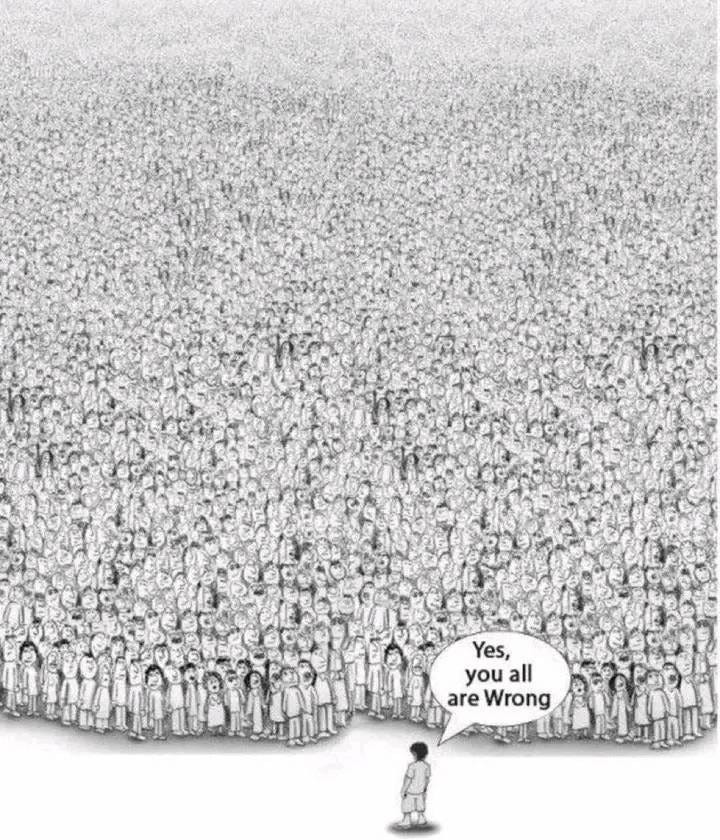
Notice that he’s relaxed. He’s not screaming a proclamation. He’s not making himself better than all these other people. He’s just stating a fact: they’re all disagreeing with the truth. It’s not even about him. The mob could rush him and kill him, and they’d still be wrong, and he knows it.
…and he’s willing to say it. To let the truth speak through him.
Some of that can come from nervous system regulation. That helps deal with the anti-gnosis that intimidation can induce. But here I’m more interested in the capacity to voice and act on the gnostic truth even when terrified. I don’t think Gandhi, or MLK Jr., or the Founding Fathers of America were doing what they were doing because they felt safe.
Likewise, the figure in the above image might have an easier time if he knows he won’t be attacked, physically or socially. But gnostic courage lets him speak even without that reassurance. He’s willing to back the truth even when others don’t give it permission to exist.
It’s possible to mimic the behavior of courage by letting an idea (meme) ramp up fight-or-flight type energy and override the fear with planned behavior. But that can (and I think usually does) become a vector for unhelpful memes. Courage as I mean it is different from this — something like, the willingness to choose to die rather than misalign from what you gnostically know to be true. Not just because you think that’s important, but because deeper than mind, you’re unwilling to compromise your soul’s integrity regardless of the cost.
I don’t have a satisfying mental model of courage yet. I just get the sense that it’s very real, and very important. Like a flame from the heart that purifies the mind and protects its gates. It’s something like a ferocious and daring devotion to what truly matters, a deep readiness to face profound heartbreak, and an embodied willingness to act and speak in alignment with all of that regardless of what it might cost. Not as a virtue or an idea of what one should do, but because of blazing clarity that nothing could possibly be more right than utter devotion to what matters beneath appearances and form. That the costs might hurt, and the hurt matters, but the costs are nothing when compared to the rightness and beauty of aligning with life.
I hope you can hear and feel that I don’t mean to prescribe action. I’m not saying we should push ourselves to say difficult true things. (I think trying might make it harder for our minds to let us even recognize difficult true things!) I’m saying there’s something like gnosis of the heart.9 It’s a direct knowing about what matters. It’s in the aliveness of being, and in seeing the deadness of going along with soul-crushing systems. It’s in the fact that Burning Man builds a Temple every year.
And somehow we keep forgetting. We keep losing track of what truly matters.10
It’s as though there are structures in our autopilot that do not serve life and would not survive our deepest, most burning clarity. So they lull us into sleep lest we wake up and roar.
By courage I mean something like the capacity to fully show up for what matters even while these structures try to stop us.
So if we could live courageously, only the memes that help us care for what’s precious would be able to survive through us.
Gnosis of gnosis
Gnosis is nearly defined by passing the self-reference check. It is self-validating. You know gnosis is right because that’s what gnosis is.
One implication here is that you cannot receive an understanding of gnosis from me or any other outside source. Instead, you recognize it. You “aletheia” (un-forget) it.11
So if there’s any hint here of you feeling persuaded of or argued into agreeing with this idea, that’s not it!
If you catch a glimpse of what I’m talking about, it becomes irrelevant that I was the one talking about it. The details of how I’ve phrased it don’t matter anymore. The knowing is unalienably yours.
In mathema, this shows up as how no teacher or text or outside source can tell you if you’ve understood a proof. They might try. A skilled tutor might notice whether a pupil seems to really grasp the proof as opposed to socially performing an understanding. But the flash of utter clarity, the knowing that can never be invalidated by any authority, is something that the person in question can tell for themselves has happened — and that’s how they know it has happened.
These days I hear a lot of folk (especially in spiritual or relational circles) talking about whether something “resonates” or “feels true”. The degree to which many people who talk like this are often memetically hackable is embarrassing. Resonance in this sense isn’t necessarily from gnosis. That becomes extremely clear the more sharply you learn to recognize how gnosis is prior to sensation. These gut-feels are often an intuitive ping of familiarity, telling you whether what you’re hearing is compatible with the memes you tend to listen to and that you’ve let carve your physical intuitions.
For instance, I’ve met quite a few Christians who are hyper attuned to when something has sexual charge. It “feels impure” to them. They can totally tell that the sexual energy they’re encountering isn’t compatible with their Christian practices. That’s accurate! But it gets conflated with a claim that it’s objectively wrong, or that it’s bad for everyone. At that point the Christian memetic structure is speaking for them.
Where does the validity of “resonance” come from? Why trust that sensation, instead of some other sensation? Is it for reasons, which memes can rehearse in the mind? Is it naïve trust, where a person believes it because it just… feels better?
To be clear, I’m not saying resonance is bad to use. I’m saying that it’s precarious to rely on it as one’s compass through memetic ecosystems.
It’s like something to know you’re choosing to (say) move your fingers at will. How can you tell? Because that’s what choice is. That’s what being able to tell anything at all is. That doesn’t just “resonate”. It’s true.
Memes cannot corrupt this clarity. They can corrupt your mind’s reflection of this clarity, but not the vivid knowing itself. A mind that biases toward increasing the clarity of its gnostic reflection will incline the memes that pass through it to align with what the heart knows matters.
If that isn’t obvious to you, then you haven’t seen the thing I’m trying to name yet.
If I’ve earned your trust enough for you to suppose that I’m pointing at something real, then use this guideline as a sketch of a proof. See if you can see it for yourself.
Not a single bit of this has to do with believing me, or my ideas.
If what I’ve just said seems redundant, tautological, and maybe obviously phased wrong in a few places… then maybe you’ve got it.
But I can’t tell you.
It’s yours to tell for yourself.
Modern footnote: There’s an irony here I missed when originally writing this series: Newton didn’t call his work “Principia Scientia”. There’s good reason for the name of course. By his time, “mathematica” was the standard Latin word for what we’d now call “mathematics”. He was trying to title the book “Principles of Math”, not “Principles of Knowing”. All the same, I find it funny that I used that particular title to make my linguistics point.
My favorite is Cauchy’s proof: you can cut the faces of a polyhedron into triangles without changing the Euler characteristic (since you add one edge and one face with each cut). If you blow the whole shape up like a balloon so it’s a sphere, remove a face, and then put your eye at the level of the (curved) removed face, you can see all the faces. Each time you remove one of the wiggly triangles at the edge of the opening, you’re removing two edges, one vertex, and one face — so no change in characteristic. Because you can see the whole surface at once, this process eventually leaves you with one triangle, whose characteristic is 1. But you started by removing a face. Ergo, you always get 2.
E.g., Cauchy’s proof (given in the previous footnote) assumes that it’s possible to blow the shape up like a balloon, peer inside from one place, and then see all of the shape’s surfaces. It turns out that assuming that’s possible is basically assuming that the Euler characteristic is 2 — and the proof traces why that’s true.
Modern footnote: A few months after I first wrote this whole section on social anti-gnosis, I finished working out the logic of the hostile telepaths problem. So if you’re familiar with that idea, you might recognize it here. However, social anti-gnosis is a yet more general idea; see for instance social control disorders, which can arise without there being any sense of dealing with a hostile telepath. The main point being that supposed “irrationality” is always there for a reason, and usually that reason is that you’re using it to solve a problem socially.
I sometimes wonder if this is central to the Gnostic contrast between the demiurge and the True God (“Pleroma”). Anytime we’re inclined to view the True God as a being, we’re actually talking about the demiurge again. Because language comes from the mind, and the mind works via reification, all attempts to talk about the True God will necessarily get twisted into a self-hiding confusion. So maybe “the demiurge” is a projection of the mind’s error modes that filter out various wholesome ways of being and living.
Importantly, the sequence never actually fires on its own. It’s always prompted somehow. It’s just pretty common to miss the flicker that set it off — sometimes because the whole point of the sequence is to distract us from exactly that flicker!
I think this a big reason is why people often talk about death as some kind of gift. It’s not that death itself is wonderful. It’s that it opens our hearts in ways we believe we’ve lost the power to do on our own.
It’s valuable to remember that memes say things to us using our own minds. They generally don’t act like entities inside us having a negotiation. They often grab the selfing process and act like they are us. So when a meme relies on us not choosing to intervene on its behavior, and it tries to tell us we don’t have the power to intervene, it rarely sounds like “You’re powerless to stop me.” It usually sounds more like you thinking to yourself “I’m powerless here.”
The English word “courage” comes from the same root as the French word “cœur”, meaning “heart”.
Lines like this one foreshadow part 5.
The Greek word “αληθεια” (“aletheia”) isn’t really a verb. It’s a noun, meaning something like “forgetfulness”. The verb form is “αληθευω” (“aletheuo”), and the second person conjugation is “αληθευεις” (“aletheueis”). So technically it should be “You aletheueis it.” But I think that’s less clear, so I’m going to keep butchering the Greek upon occasion.