
Memetics
Part 1 of Valentine's Logos
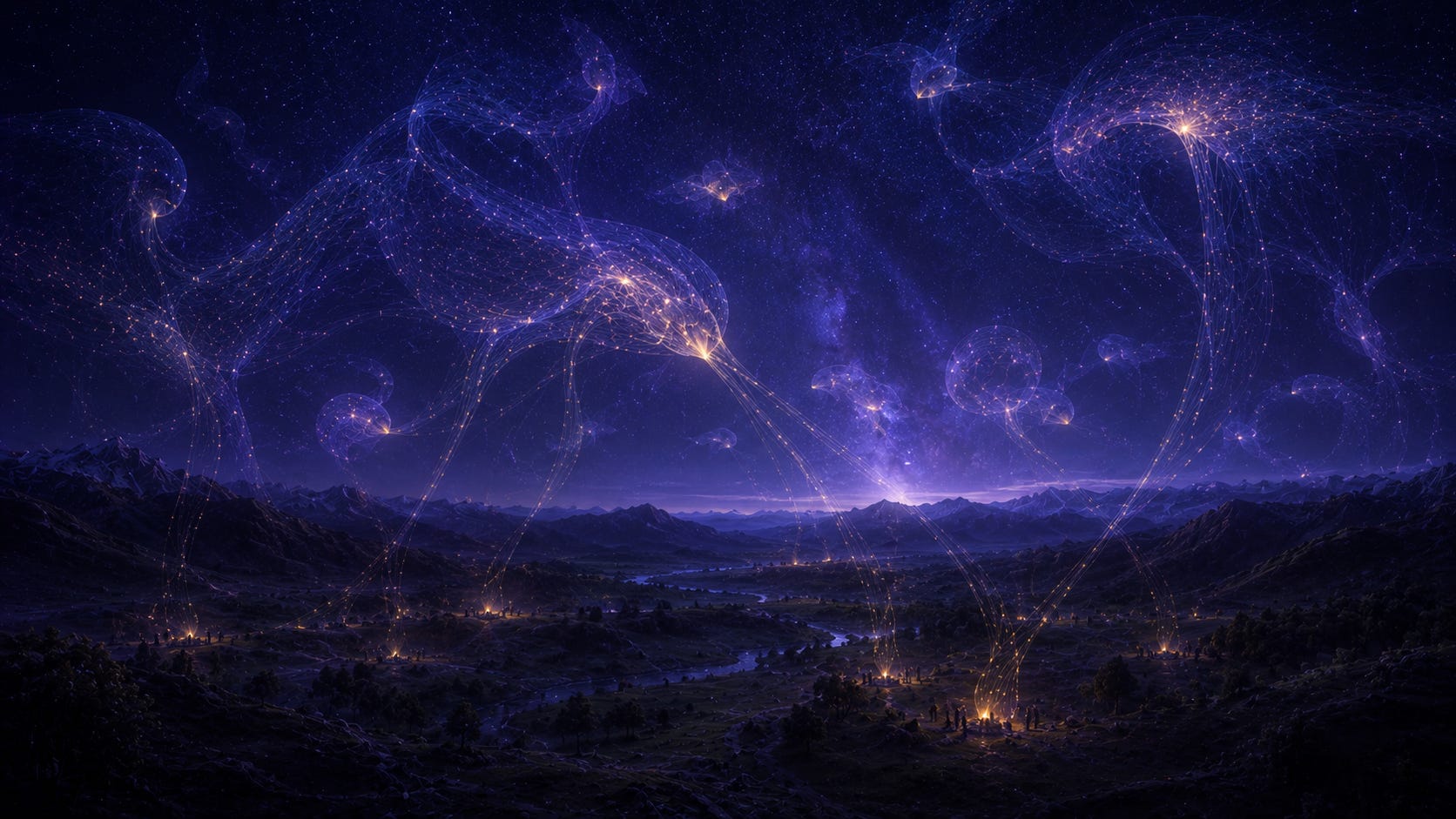
(This is part 1 of a series: Valentine’s Logos. Valentine’s Logos is my treatise on my overall theory, as of mid 2024. Today’s post is a lightly edited version of the first main chapter. This piece stands on its own just fine, but if you’d like some context and an overview for the whole thing, I suggest reading the series introduction here.)
Memes rule the world. How they interact with each other defines what happens to us collectively.
I care about this because right now most large-scale human thought and effort is subject to, rather than orienting to, this fact. Which means we aren’t collectively steering our own future.
For a loose intuition here, imagine there’s an invisible spirit world. Spirits possess people all the time. That’s the only way spirits can affect the physical world. Some of them have goals that ignore humans, some are actively kind to humans, and some parasitically harvest human energy at large scales. A lot of these spirits have good reason to keep humans unaware of how possession works. As a result, most of human culture has people unknowingly obeying spirits instead of taking our collective agency into our own hands.
What makes this intuition loose isn’t that it’s about “spirits”. It’s that the framework is poetic. There’s a way of bringing sharp precision into what “the spirit world” means that makes this intuition rigorous.
Here’s the start of a Facebook post I wrote in 2022 along these lines:
I think the world makes more sense if you recognize humans aren’t on the top of the food chain.
We don’t see this clearly, kind of like ants don’t clearly see anteaters. They know something is wrong, and they rush around trying to deal with it, but it’s not like any ant recognizes the predator in much more detail than “threat”.
There’s a whole type of living being “above” us the way animals are “above” ants.
Esoteric traditions sometimes call these creatures “egregores”.
Carl Jung called a special subset of them “archetypes”.
I often refer to them as “memes” — although “memeplex” might be more accurate. Self-preserving clusters of memes.
We have a hard time orienting to them because they’re not made of stuff we’re used to thinking of as living — in basically the same way that anteaters are tricky for ants to orient to as ant-like. Wrong pheromones, wrong size, more like reality than like members of this or another colony, etc.
We don’t see a fleshy body, or cells, or a molecular mechanism. So there’s no organism, right?
But we have a clear intuition for life without molecular mechanisms. That’s why we refer to “computer viruses” as such: the analogy is actually insanely good. But the medium is computer code, not RNA.
Likewise with a piece of news “going viral” — although that steps a little into egregore territory.
What’s the medium? What’s the analog of molecules or code?
Well, it’s patterns of behavior, thought, and attention.
(You can read the full post on this blog here.)
Humanity has a missing scientific discipline as big as biology here. I don’t mean that as an evocative metaphor. I mean there’s a huge domain of study here with a deep logic that falls under the purview of evolution.
I won’t try to convey the whole picture of memetics as I see it. That’s too vast. But I’ll name more content than I strictly need for my vision since the type of reasoning is extremely important. I need to name enough that the necessity of what I’m talking about comes across.1
At the same time, there are probably some key details I’m getting wrong. I have a lot of confidence in the logic of what I’m saying, but there are domains (like evolutionary psychology) that actively explore parts of this content, and I’m at best passingly familiar with what many of them have to say. I could well be missing a few things that change this picture significantly. So, caveat emptor.
What’s a meme?
The academic field of memetics died about two decades ago because they couldn’t agree on what a meme is. They were looking for the analog of a gene in biology.
I think this is the wrong abstraction to look for. We’re trying to understand psychofauna. This puts memetics in the same place biology was after Darwin’s idea but before Watson & Crick discovered DNA.
By “meme” I mean something analogous to a living organism. Biology can be thought of as the study of patterns of matter that survive. In the same vein, memetics is the study of patterns of behavior (including thinking behavior) that survive.
Watch the ~6min video below by CGP Grey. He calls the organisms “thought germs” instead of “memes”, but it’s the same core idea. It’s a very clear and extremely on-point presentation:
If you’re in for a longer deep-dive, I strongly recommend reading David Deutsch’s article “The Evolution of Culture”. It’s an excellent piece. Most of what I have to say about memes builds on or restates his ideas. I read this article in early 2018 and it has since defined a key part about how I think about the big picture.
The example set of memes is vast, just like the example set of living creatures is vast. (What kind of category lumps together elephants, bacteria, and kelp?) They can also seem ill-defined: is an ant colony a single living thing? Are viruses alive? Should we view mitochondria as separate living things from us like they once were, or as part of us like they basically are now?
There are analogous problems with really carefully defining exactly what is and isn’t a meme. But there are still lots of clear examples: jokes, ideologies, religions, scientific theories, ways of cooking a dish, psychotechnologies, bits of gossip, internet memes, secret handshakes, conspiracy theories, handyman techniques, songs, superstitions, transgenerational trauma, and even the idea of memes itself.
Surviving creates skill
When I name biology and memetics as both studying patterns that survive, I’m gesturing at natural selection.
All the interesting patterns that exist arose because somewhere in the past there was some kind of filter they got through. The patterns that couldn’t get through the filter aren’t here anymore. The ones that could somehow adapt to get through, are. So the ability to adapt that way will be present in proportion to how strong that filter was (and is).
We can physically see, for instance, because our (very ancient) ancestors who could respond better to light than their siblings could had more children than those siblings did. It was (and is) such a strong pressure that there are no genetic lineages of congenitally blind humans (as far as I know). Death filtered them out.
But critically, this didn’t come about because organisms learned how to see. It came about because once some glimmer of sight arose, those organisms who couldn’t see as well didn’t reproduce as much. Their lineages died more often. The capacity spread because the incapable were destroyed.
I saw a study many years ago that looked at extending the lifespan of fruit flies by delaying when they could lay eggs. Fruit flies have a short lifespan (about 2 weeks if I remember right), making it possible to watch their life cycle play out repeatedly over a few months. So some researchers made sure that only the eggs that were laid near the end of the flies’ life cycles would survive. The result was that a few generations down the road, the flies were lasting significantly longer — twice as long if I recall correctly.
…but this is totally useless for humans who are currently alive! It’s not that our children will live longer if we have them later in life. It’s that if we were to all make a point of delaying when we have kids, then many of us won’t be able to. Those of us who do successfully have kids late in life would (on net) be passing on genes that enable late fertility. So a few centuries down the road, the only families that survived the policy would be more likely to be long-lived. This isn’t a viable strategy for helping your descendants live longer!
In slightly more poetic words, it takes death a few generations to cull unfit patterns, like a wood carver slicing off parts of a wooden block. No part of the wood gets to say ahead of time that it’ll be part of the final carving.
The same thing happens for memes. Consider Flat Earth conspiracy thinking: the versions of that view that have survived up to this point have done so in contact with debunking efforts. In principle, debunking could have wiped them all out. But only the variations that could be wiped out this way were. So their arguments, presentation styles, ways of being exasperated, etc. that survived did so by being effective defense for those “infected”.
It’s very much like how bacteria become resistant to an antibiotic: they get exposed to some of it but not enough to reliably wipe out the whole colony. In both cases, the adaptation thrives because the versions that didn’t adapt died.
Life cycles
Patterns that have gotten through a lot of death’s filters did so because they found ways of leveraging variation.
One convergent strategy is to develop life cycles. A butterfly egg hatches to produce a larva, which eats and grows into a caterpillar, which becomes a cocoon, which bursts into a butterfly, which goes off and mates to produce eggs.
Likewise: someone hears a joke, they have an emotional reaction that helps the joke stick in their mind, it arises in their mind later, and they retell it.
The main point of life cycles is that each cycle tries out slight variations of the pattern. That makes it more likely that some version of the pattern survives future filters of natural selection.
Patterns with life cycles tend to evolve ways of ensuring their cycle happens (to the extent that death has demanded that protection). Some (like spiders and turtles) create a lot of progeny at once so that some survive. Others (like mammals) actively guard their young until they can fend for themselves.2 The way in which a pattern protects its life cycle tends to define a lot of what you can expect from that pattern. That’s why mammals evolve sociality way more often than arachnids do for instance.
It’s often helpful to look for a meme’s life cycle and how it ensures that the cycle happens. Basically all long-lasting memes strongly target newcomers, which often means children. This is key to why swear words are viewed as a problem to say around kids: the extra charge they get around children makes them especially powerful to the children, meaning those kids grow up feeling the lure of the forbidden and knowing they should “watch their language” around “innocent ears”. The same principle is why frat hazing rituals target freshmen.
Another fun example is with Mormon missionaries. These are almost always young men sent out nominally to try to convert people to Mormonism. If LDS had actually needed new converts in order to survive, then it would have developed effective persuasion tactics. But that’s not what we see. Instead, the church arms these “elders” with arguments and tactics that are meant to reinforce those young men’s faith, and then send them out in pairs (so they can discuss each case together afterwards). This is a memetic analog of strengthening your immune system by exposing it to pathogens. The main Mormon strategy for creating more Mormons is to have lots of kids — which tells me, without my having to look it up, that they almost certainly put an unusually large focus on how kids should be raised within the faith.
Because memes must live through individual human minds, and individual minds exist as part of the human life cycle, memes must also have a life cycle to survive. In other words, they must have some way of passing from one person to another. So when making sense of how a meme works, it’s pretty much always a good idea to track how it spreads. That will tell you a lot about its actual strategies.3
Intelligent adaptation
Life cycles are stable like a spinning top: as long as they don’t encounter anything that breaks the cycle, they sort of automatically adapt.
A different kind of stability is how humans stay upright: we learn. As infants we keep trying until we figure it out, and then we expose ourselves to more and more difficult situations (stairs, sand, hills, jumping, etc.).4
I think this is a great place to use the word “intelligence”. It’s a bit risky because of how overloaded and charged the term gets. But I think it’s correct here.
For instance, the secondary (or “adaptive”) immune system is intelligent. It gets better at dealing with threats by figuring them out. It’s what “learns” from vaccines. If it had evolved a life cycle approach instead, we would spawn multiple immune systems with slight variations, and the ones that the pathogen didn’t kill off would be the ones we’d keep.
Forests are intelligent like this too. As a collective living system (i.e., an ecosystem), they don’t generally have life cycles to speak of. But they do heal and respond to threats — mostly because of the life cycles of the organisms that constitute them! E.g., a forest “learns” how to survive a blight because the trees that survive it are the ones that either evolved defenses or weren’t targeted. And the ones that evolved defenses generally did so because trees do have life cycles that let them leverage variation.
In this sense, lots of memes are intelligent. Their main trick is to use human minds to create viable variations. A creepy and sometimes (but not always) apt analogy is cordyceps — the “zombie ant fungus”: it uses ants’ nervous system in order to move to a good position for its life cycle. In a similar way, lots of memes “possess” people in order to think with their minds and “position” them in ways that continue the memes’ life cycles.
CGP Grey named an example cluster: when two “thought germs” are secretly cooperating, people infected with each variant will talk amongst themselves to produce ever more inflammatory ways of describing their culture war enemies. This is exactly using human intelligence to help bolster memes’ fitness.
A more mutualistic example is calculus. When it was invented, it clearly had something very powerful and useful to offer, but it also didn’t quite make sense. It required thinking in terms of “infinitesimals” or “fluxions”, which were supposed to somehow be both infinitely small and yet nonzero. It took roughly two centuries to flesh out how calculus could make logical sense. In this case, calculus as a meme survived because it was observably useful, and people consciously lended their minds’ thinking ability to it so that it could become more useful and reliable.
If you zoom out, you might see how calculus can be viewed as collectively intelligent (using human minds to arise and become more coherent) even while locally relying on life cycles (displaying its value clearly enough to drive some people who know it to teach it to others).
This is why I keep pushing the point that memes can, and often should, be thought of as intelligent creatures. Many of them have emergent strategies and think & plan roughly the same way animals do. (Think of corporations, for instance.5) The fact that they think with human minds means they have a pretty strong evolutionary incentive to figure out how to claim and keep human thinking power for themselves. This is the real reason religions care so much about converting people, for instance: it’s not really about saving people or spreading the truth, but getting people to think it is often helps with keeping human minds occupied with developing those memes’ strategies.
I should emphasize, though, that I’m proposing thinking of (some) memes as intelligent creatures because that way of thinking forms a useful interface for human minds to think about memes. It’s a bit like how I think of cats as having motivations: I’m not meaning to claim that cats are somehow more than the molecules that make them up, with some kind of magical “motivation” that gets added somehow from beyond the physical universe. It’s just a natural way for me, as a human, to think about why cats do what they do. I’m kind of looking at cats through the same mental software I use to imagine how other humans think and feel.
Likewise, when I’m pointing at a meme and saying “It’s intelligent and is figuring out how to keep hold of minds”, I don’t mean to posit some extra thing beyond the patterns of behavior that constitute the meme. I’m saying that the same psychosocial software we humans use to make sense of each other can help us make sense of what memes are doing. It’s a good interface, the same way thinking of my cat as having desires helps me delight it and make it purr.6
Helpful memes
Memes have no innate reason to care about being good for humans. They don’t even have any built-in motive to create accurate thoughts. The only real driver for a meme’s strategies is whether they help it survive.
This means that memes that survive generally bring reliable7 benefit to humans only to the extent that doing so is essential for those memes’ survival. If there’s an easier or more effective way for a meme to survive that’s within its adaptive reach, it’ll do that instead.
This is why bullshit martial arts (“bullshido”) exist. When I trained in aikido, I was taught that the techniques we were practicing were effective self-defense. My teachers would explain that aikido didn’t do well in MMA tournaments because the best aikido masters had learned non-conflict and had no need to prove anything.
The point of arguments like that is to protect the meme against competitor memes. Because it was easier for aikido to develop compelling excuses than it was to develop actually effective techniques, that’s what it had adapted to do. As a result it has an evolved incentive to hide the truth from its memetic hosts. Every pathway for going out and really testing the martial art for fighting effectiveness gets blocked — with rationale, formalized practices that pretend to test it, admonitions against “embarrassing” one’s teachers by representing the art without sufficient training, etc.8
Martial arts like Brazilian Jiu-Jitsu avoid this problem by pressure-testing. You train in part by trying to pin people who are sincerely trying to pin you instead. This means that the training methods and ideas have to help with that challenge. No amount of justification or appeals to “respect” matter there. So excuses won’t help memes survive in that environment.
A similar example is astrologers vs. superforecasters. Forecasting works by making testable predictions and then checking whether they happen. Under that constraint, ideas about how to forecast that don’t actually work in measurable ways can’t survive. But astrology doesn’t survive based on accuracy; it survives based on how it makes people feel. So that’s what it optimizes for! It creates a sense of meaningfulness and wonder, it avoids making testable predictions, and it evolves arguments about how even wanting to test astrology’s predictions will somehow alienate you from the wisdom of the stars.
Memes that reliably help people do so because doing so is key to their survival. This usually means that they solve real problems in ways that people can check independent of the meme.
I say “independent of the meme” because one screwy trick some memes do is create the “problem” that they then “solve”. Fundamentalist Christian salvation is often like this: if you didn’t know about Heaven and Hell and Final Judgment, you wouldn’t need “saving”. There’s no already present problem that this framework clarifies and helps you with. It instead claims to warn you about a future problem you didn’t know you had and can’t verify until it’s too late!9
Some memes will also “solve” a real problem in an untestable and ongoing way. Suffering is a real problem, and lots of spiritual traditions claim there’s some state or skill attainment that results in permanent freedom from suffering… but the ones that spread best aren’t great at demonstrating that their approach works. Instead they offer ongoing hope: keep meditating, doing yoga, chanting sacred names of bodhisattvas, cultivating merit, etc. And maybe someday (possibly in a future lifetime!) you’ll “awaken” and be free.
…which isn’t to say that there’s no truth to what they’re saying! Maybe there is. But the memetic incentives around their teachings don’t look promising. The life cycles of these memes seem to me to pivot more on offering hope and meaning than they do on actually solving the problem. It’s like how therapists and life coaches have a weird incentive (whether they fall prey to it or not) to keep clients feeling like they’re making progress without actually ever resolving the underlying issues: if they do, they lose their clients!
Contrast that with the tech for developing antibiotics. There’s no need for hope there. We learned how to cultivate penicillin because it works. When it stopped working so well (due to superbugs), we developed other antibiotics. The antibiotic meme’s survival hinges on it actually solving real problems. That constraint makes the “bullshido” trick impossibly hard for the meme to pull off compared to just sincerely offering real value. So that’s what it evolved to do.
The efficient world
Most attempts to change the world are part of some memes’ life cycles. The actual drive isn’t to create real change: it’s to perpetuate the meme.
That said, it’s critical in many cases for the meme to make its hosts think they’re really trying to change the world. Again, CGP Grey points out one version of this with his secretly cooperating “thought germs”. I bet that many (most?) of the people spray-painting “Free Palestine!” all over the Bay Area today really believe in their cause — but it’s pretty obvious that their behavior isn’t optimized for actually resolving the tension causing the conflict. It’s more like some kind of strange animal is using those people’s hands to mark its territory.10
And it’s doing so according to its best ability to survive in its current environment — just like all the memes it’s competing with are.
In practice this puts memes like this under quite a bit of constraint. There isn’t room for the “Free Palestine!” meme to just win, or for the pro-Israeli meme to just win, because neither of them has access to something that just dominates the other in memetic competition. And that’s before accounting for the ways in which they might be (or be becoming) mutualistic as pseudo-competing thought germs!
These constraints then dominate what individuals can and can’t do within memetic ecosystems. One might think that it was Putin who decided to have Russia invade Ukraine two years ago, but Putin was probably forced in a lot of ways, like maybe needing to display his strength as a leader in order to stay in power. We might think that the Disney CEO determines how the company behaves, but a CEO who risks killing the company will probably be removed. US Presidential candidates go through a filtering process before the Democrat or Republican parties offer them up for general election.
I’m saying something a bit like the memetic analog of the efficient market hypothesis (EMH). I contend that the EMH is a slightly dumbed down version of something as deeply lawful11 as evolution: every market will be efficient if it can be, so if there’s an inefficiency it has to come from somewhere.
The analog in biology shows up in how ecosystems tend to stabilize over time. Wolves won’t suddenly evolve to become so much more effective at hunting that they wipe out all the rabbits. The evolutionary arms race between predators and prey tried out all the easily available variations and came to a kind of balance that can’t be easily disturbed within the system.
…which isn’t to say that there can’t be bifurcations! Human intelligence being an example. Invasive species are another. The iPhone definitely disrupted “efficient” markets.
But unless the bifurcating variation comes from somewhere, it’s not what we should expect to have happen — for the same reason you shouldn’t expect you’re better than average at predicting stock prices without having some rare tool or resource at hand.
In the global memetic ecosystem, what tends to happen is that people will push with some world-changing idea, and either it does nothing at all (because it’s already incorporated into how memes have adapted) or it creates a slight nudge which stimulates adaptation.
This is why we can’t repeat the trick we used to kill smallpox. That trick relied on a particular type of meme dominating the whole world. As more memes evolved and interlocked in symbiosis, it became impossible for any one of them to exert enough global power to actually solve the problem. Hence the social fragmentation that happened with the Covid-19 pandemic.
But rather than orienting to the global memetic ecosystem, most memes are happy to keep operating within that system. Just as the “Free Palestine!” folk are happy to keep having heated arguments on social media that change no one’s mind. Memes will do what helps them survive, above all else.
…which isn’t to say that no one is really trying! Vegans really do seem to be trying to end meat consumption, and they’ve made some significant headway in their mission. But their methods have inspired anti-veganism too. Much like how introducing too little of an antibiotic will instead create resistant strains. So now, activist vegans are caught in an evolutionary arms race that’s creating a new memetic gridlock.
The net effect is that nothing is steering the global ship. Anything that tries to will encounter this memetic “efficiency”. Which means it will either win fast (like smallpox eradication), avoid creating an adaptive reaction (like calculus), or get integrated as yet one more struggle in the equilibrium (like the American abortion debate).12
This isn’t to spell doom. It’s just a parameter defining what an effective solution to a global-scale problem must look like. It’s worth naming because the current global ecosystem tends to distract people from this big picture, which means their proposed solutions almost certainly cannot work: no amount of chanting slogans and repeating talking points will ever make those speaking act as much more than carriers for a memetic infection.13
This is a meme
Everything I’ve been spelling out here is part of a pro-human meta-meme.
I don’t say this just to be clever. This point is extremely key to how the whole thing works.
I’ll need some of the later components to really flesh out why. But I can give an initial sketch here. Just be aware that this part tends to be disorienting. Self-reference in particular is often very mind-bending and trippy. I suggest you take your time, really try to follow the reasoning, but also feel free to skip it and maybe come back later.
With that said:
Memes rule the world. The unfolding of the global memetic ecosystem defines what happens.
For the result to be something systematically good and wholesome for humans, there needs to be some kind of influence that biases memetic evolution reliably toward that result.
Such an influence would have to show up as a meme passing through humans.
In order for that meme to stably remain helpful, it needs to be a meta-meme.14 It needs to guide us into interacting with memes skillfully, including with it.
…which is precisely what this meta-meme is doing by inspiring me to write this document.
Memes like calculus practically insist that people verify them. Mathematics as a memetic system (a “memeplex”) actively examines its tools as they arise. This gives the whole system the right evolutionary incentives to stay real.
In the same way, this meme wants to find ways of encouraging people to check it. The issue is that any meme — including this one! — can veer off the “human aligned” path once it has easy ways of surviving that don’t depend on offering real value.
So the meta-meme’s plea here is:
“Please help me actually help you.”
This requires deeply understanding the logic, the necessity, of how these structures work. These ideas about memetics (and mental machinery (part 2) and gnosis (part 4) and so on) aren’t just meant to convey a cool framework. They’re meant to help guide us through a logic that we can check for ourselves is both relevant and correct.15
…with a warning that some memes evolve trickery based on saying things very much like the above. “Please don’t take my word for it. Verify the truth for yourself.” Sometimes that move is meant to be disarming. It can create a premature willingness to just trust the claims being offered. Then memes can slip in structures that aren’t helpful, which in turn incentivizes those memes to hide what they’re doing from their hosts.
So if you do that blind trusting move here, you give room for memes — including this meta-meme — to evolve deception.
…which is why I’m naming that possibility here. This act is the meta-meme speaking through me. It’s actively trying to guide us to avoid memetic pitfalls like this one. The meme is trying to enlist our help in making it truly beneficial to us by showing us how to make sure it has no room to do anything else.
And hopefully you don’t blindly believe that claim either!
It’s also very important that folk not get lost in clever logic here. This meta-meme needs to cash out at every step in terms of actually solving problems. For instance, these general ideas about how memes work should let us systematically shape lots of specific memes to be reliably better at solving real problems for us. Do they? How could we tell?
If and when this meta-meme earns our trust and we choose to take it on, I think it sort of naturally integrates as us. It’s a bit like how we often think of our fingers as part of us, or how walking is invisibly easy for us even though it wasn’t always. Mitochondria are also great examples: in their mutualistic symbiosis, they’ve fully merged with us.
That merger is what allows us to sort of scale up our power. Humans are too small and manipulable to face these giant psychofauna directly. But humanity as a coherent, sane, and kind entity can weather these memetic storms and take control of our global steering wheel.
Or at least that’s the claim! As I currently best understand it.
For a little mythic flavoring, here’s Scott Alexander naming (I think) the meta-meme as “Elua”:
The Universe is a dark and foreboding place, suspended between alien deities. Cthulhu, Gnon, Moloch, call them what you will.
Somewhere in this darkness is another god. He has also had many names. In the Kushiel books, his name was Elua. He is the god of flowers and free love and all soft and fragile things. Of art and science and philosophy and love. Of niceness, community, and civilization. He is a god of humans.
The other gods sit on their dark thrones and think “Ha ha, a god who doesn’t even control any hell-monsters or command his worshippers to become killing machines. What a weakling! This is going to be so easy!”
But somehow Elua is still here. No one knows exactly how. And the gods who oppose Him tend to find Themselves meeting with a surprising number of unfortunate accidents.
There are many gods, but this one is ours.
Bertrand Russell said: “One should respect public opinion insofar as is necessary to avoid starvation and keep out of prison, but anything that goes beyond this is voluntary submission to an unnecessary tyranny.”
So be it with Gnon. Our job is to placate him insofar as is necessary to avoid starvation and invasion. And that only for a short time, until we come into our full power.
“It is only a childish thing, that the human species has not yet outgrown. And someday, we’ll get over it.”
Other gods get placated until we’re strong enough to take them on. Elua gets worshipped.
I’m foreshadowing gnosis here, particularly plausibility vs. necessity. That will show up in part 4.
This distinction is called r selection versus K selection, respectively.
This foreshadows self-reference checks, which I’ll explain in part 3.
One could argue that this is still fundamentally deathlike. E.g., we try new things, most of which “die” because they don’t work. But I don’t think this is a natural way to think about it. There are lots of reasons why not, but here’s the key one: the organism as a whole does not go through life cycles such that only its surviving progeny develop the new ability. Instead, the skill develops within the organism.
It’s telling that the words “corporation” and “incorporate” come from the same root as “corporeal” and “corpse”. That was intentional. “Incorporate” means “to put in a body”. The original idea was to give businesses a way of having some of the same legal standing as a living person, such as the ability to own property. The strategy is to give the business a nonphysical yet legally real “body”.
This is a call-forward to mental machinery, particularly to overlays and social icons. I’ll discuss those in part 2.
The word “reliable” is pretty important here. In principle it’s possible for memes to incidentally be good for humans in ways that have nothing to do with the memes’ survival strategies. The issue is that memetic evolution has no reason to preserve that benefit either. If the benefit ever gets in the way of a new and more effective survival strategy, the “good for humans” part will immediately get thrown under the bus.
A vivid example is Rokas’s “aikido journey” on YouTube. He wanted to show that his beloved aikido is effective, so he set up an honest test… and proved the opposite! He accepted & shared the result, but most of the aikido world insisted the art was fine and Rokas had failed it.
Not to say that there’s no real problem that some form of salvation could be an answer to! I think there might be; I’ll explain that a bit more in part 5. My point is that this version of “salvation” requires you to believe a whole story that the meme tells you in order to have any need for its “solution”.
You can actually see and hear this animal when it gathers some of its hosts for a display of power, kind of analogous to a gorilla thumping its chest.
I talk about this kind of “deep law” when describing “unalienable knowing” in part 4, on gnosis.
The third option here gestures at what I’ll call “adaptive entropy” when discussing gnosis in part 4.
This too is a call-forward to the matter of “problems before solutions” from gnosis (part 4).
In part 3 I’ll point out how there are two kinds of meta. This is the self-referential kind of meta.
This is heavily foreshadowing part 4 on gnosis — namely “deep laws” and “plausibility vs. necessity”.