I’d like to offer a different vision of astrological Saturn.
Modern astrology depicts Saturn as a disciplinarian, the celestial taskmaster, the bringer of mundane necessity and the drudgery of practical material existence.
But as I’ve been doing natal chart readings, I keep finding that this just doesn’t quite fit. When naming this sort of Saturnian theme in someone’s chart, they’d often react with confusion, or maybe “Huh. Yeah, I can kinda see how that fits me.” But it wouldn’t have the soul-ringing rightness I’m used to seeing with the rest of the reading. The “stern grandfather” vibe just doesn’t land.
And I could tell some important celestial note was missing.
As I’ve listened closely to Saturn’s frequency, and as I’ve let it shape me from within, I’ve come to notice a strangely familiar dark caress that carries a notably different tone:
The bringer of grief. Slowing down from fatigue and doubt and sorrow to face the truth I quietly already know. Cutting away youth and hope and joy to lay bare that which our mortal forms try never to see. The cold touch we feel when kneeling at a loved one’s fresh grave, watching the emptiness tear away everything we thought we were, exposing a raw naked spiritual truth glowing underneath the layers of illusion we’d wrapped ourselves in but that can no longer protect us from the pain.
And opening the heart in ways it had forgotten how to do on its own.
In my readings, once I resonate with and speak from this darker essence, it often calls forth tears of deep soul remembrance and undeniable truth. I find myself wanting to use my voice with gentle reverence, almost a whisper. It very, very much lands.
I later learned that this “new” frequency is actually much closer to the traditional views of Saturn in Hellenistic and Renaissance astrology. It’s still meaningfully different, to be honest, but it struck me as a confirmation that I am in fact tuning into the right god-frequency.
It also fits much, much better with the rest of Hermetic philosophy. Stunningly so. It’s almost like this fusion of tarot, alchemy, astrology, and the Qabalah have been waiting for this puzzle piece to snap into place on Saturn’s throne.
I find this dark, and bittersweet, and beautiful. Like remembering a long-forgotten precious gift and fetching it from a dusty hidden corner of the attic, aching with memory and grace.
I’d like to share this with you now.
I want to start by sharing a story from the book “Bonds That Make Us Free” by Terry Warner. It captures a snapshot of Saturn’s gift in a way I keep finding myself coming back to even a decade after having first read this.
The bold for emphasis is mine. I’m pointing out the author’s implicit conversation with the Dark One.
Take your time reading this. Pause to breathe it in as needed. Saturn’s touch caresses very tender places in the soul. The heart needs time to open and listen.
[My wife] Susan and I named one of our sons Matthew, which means “gift of God.” During the early months of his life I would dance around his crib in my pajamas, singing. Some of the songs I made up as I went along, some I had learned from my mother, and one my grandfather had taught me many years earlier:
Matthew, Matthew was a fine old man,
Washed his face in a frying pan,
Combed his hair with a wagon wheel,
And died with a toothache in his heel.
Susan would laugh. It was the best of times.
Thirteen years later Matthew appeared one afternoon at the bathroom doorway and yelled, “When’re you going to get it fixed, huh, Dad?” The downstairs toilet had been broken for several days, which meant Matthew had to use the bathroom upstairs where I was changing the baby’s diaper.
I closed my eyes for a moment and took my time acknowledging his presence. My ears began to heat up a little. How dare he talk to his father that way?
I didn’t raise my voice. Instead I set the reeking diaper in the diaper pail and observed my son standing stiffly in the doorway, arms crossed, waiting for an answer. I said, very slowly, “I am not going to answer a question put to me in that tone of voice.”
“So you’re not even going to talk to your own son, huh?”
I did not say the next thing that came into my mind, which was, “I’m not going to talk to my son until he can speak respectfully to me.” Nevertheless, he responded with a defiant “Oh yeah?” in his eyes. For a fleeting moment this reminded me of his bright eyes and spirited bearing when, at the age of nine, he sang “Wells Fargo Wagon” in the university musical. How had that charming child turned into a teenager whom, for that moment at least, I would have been happy to have out of my sight?
Summoning up my patience, I briefly considered explaining how I had tried to fix the toilet that very afternoon—but then decided he didn’t deserve the courtesy of an answer. The growing pressure of my silence was making him squirm. “Fine!” he finally exclaimed, and he huffed out the door, through the house, and down the driveway toward the Hickmans’. Probably to use their bathroom.
“Oh brother!” I heard myself say.
Hadn’t I answered with perfect self-control? Hadn’t Matthew become even more impudent? What more can a father do when his son acts like that? I picked up the baby and told myself to forget about the whole episode.
Not half an hour later I heard Matthew talking with Susan in the laundry room. He was complaining that I was so far gone I wouldn’t even talk with my own children. Susan didn’t say anything in response—she didn’t even try to correct him! All I could hear besides Matthew’s complaints was the hum of the dryer and the clicking of the snaps on the clothes going round and round inside. Couldn’t Susan see he had her eating out of his hand?
I decided to get myself downstairs to make sure the broken toilet wasn’t overflowing. I didn’t want to give Susan and Matthew more evidence against me than they already had. On the way down I nearly tripped on a pile of clothes Matthew had left on the stairway landing. For a fleeting instant I felt like yelling “What are these clothes doing here?”
But I didn’t yell. Suddenly, quite unexpectedly, all my resentful thoughts gave way to silence. As quickly as I took my next step, I could see for the first time what I had been doing, as if light had broken through a crack in the ceiling of my mind. I had been looking upon my own son as my enemy! How could I have done that? How could I have been finding satisfaction in catching him in a fault? How could I have demeaned a person I loved so well?
I knew the conventional wisdom—you need to come down hard on a boy who acts defiantly, not let him get away with it, give him a swift kick in the pants, take away his privileges. But had I done any of those things, I would have felt worse than I did. The truth that mattered was not that he had been mistreating me—perhaps he had but that’s not what stopped me in my tracks. The truth that mattered was that I had been mistreating him.
Saturn brings the truth that matters.
Not to cause shame or pain. Those are the ego’s attempts to squirm away from truths that it fears will obliterate it.
Rather, Saturn reaches within us to open us more fully to love. To remind us why we’re here.
And all precisely as we requested.
To help explain this, I’d like to share a Hermetic creation story with you. This is part of the ancient origin of why we say that natal charts reflect a person’s fate, and why each visible planet in the sky has the meaning it does.
But as I do so, remember:
This is spelling out the story of your soul’s choice to live this life.
If you recognized the glimmer of truth in Terry’s story above, the way that it whispered in your body and heart… then you know what to listen to, where to feel your soul’s inner knowing.
The ideas do matter. There’s a reason these are the Hermetic arts, brought to us through Hermes/Mercury/Odin/Thoth, the trickster god(s) of mind and language.
But the truth that matters is not Mercurial.
It’s Saturnian.
In the beginning, all is One.
Not “was”.
Is.
Time is part of the All. So from within time, from within this dream of incarnation, we experience this initial wholeness as pervading everything. This is the beginning, right here and now. This is also the end, and everything in between. This, Here and Now, is the Eternal Light.
In Hermetic Qabalah we call this “Kether”, the first Sphere.
While in bodies, we create and use minds that normally think entirely within time. So for the sake of speaking — as language is a mental art — it’s convenient to pretend there’s a sequence of events that follow this.
But your soul’s deepest essence knows better. Keep listening to that.
Next (but really in this same all-pervasive eternal Now), the Light shatters into multiplicity.

This is reflected everywhere, but in the material world we see this most clearly in the night sky: The universal Light shatters into countless separate stars glimmering in a vast darkness, each a shard of the One.
In Qabalah we call this “Chokmah”, the second Sphere — which in the material world is literally the celestial sphere doming the sky.
Each seemingly separate shard of Light acts as the seed of a soul. After being born, looking back at how you got here, it’s as though your soul started out as a spark in one of those stars and then flew to Earth to incarnate.
Chokmah also gives rise to the gods. They are frequencies, structures, wholenesses that shape the nature of incarnate experience. As we fly toward Earth — spiritually, not spatially — we converse with each god as an eternal ancient friend who is helping us to design and manifest the mortal experience we want to have.
This is why the planets appear in the sky as star-like, and yet can move around on the celestial sphere: They’re the material reflections of these divine intermediaries between the One and full incarnation, neither here on Earth like us nor fixed in the heavens like the eternal shards of Light.
But there is a spectrum of how star-like vs. incarnate-like the gods are, which we observe as celestial speed against the stars: The slowest, Saturn, touches the boundary between the Eternal and the temporal; while the swiftest, Luna, holds the gate between flesh and dream.
This gives rise to what’s known as the Chaldean order of the planetary deities — the order in which soul-seeds converse with the gods to mould and enter each ever-faster layer of incarnation:
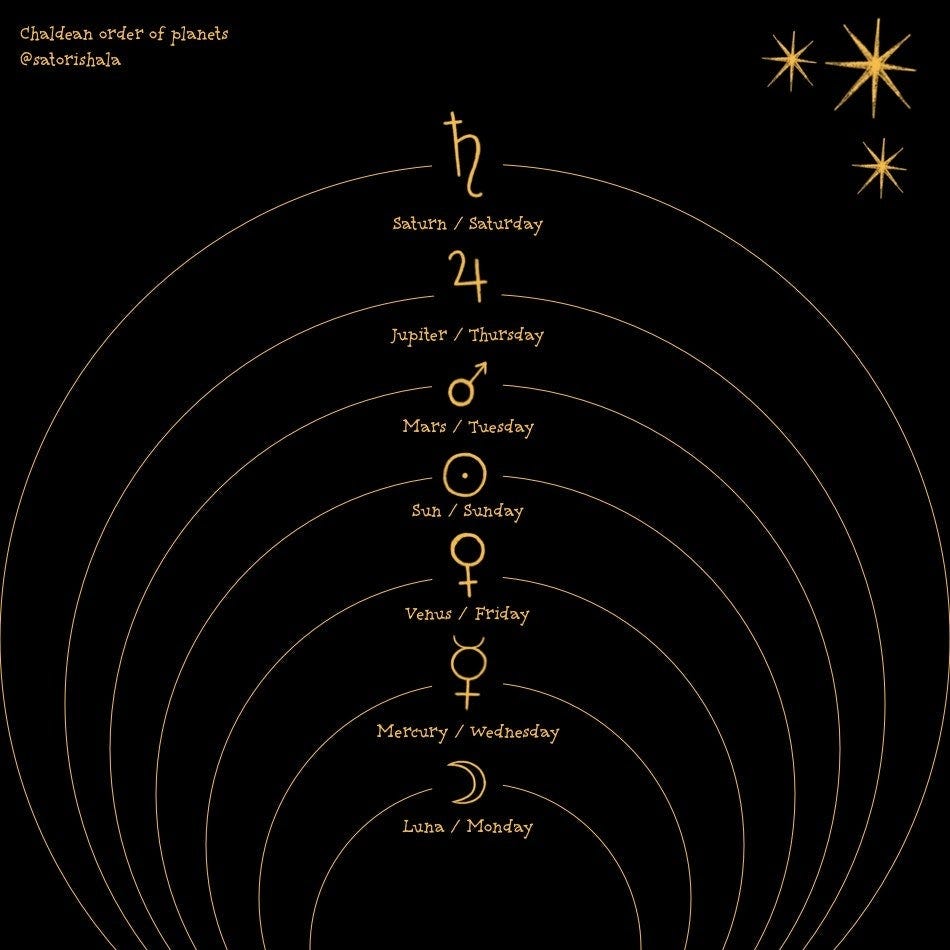
As we work out parts of our life plan with each deity, we set the context for the next god to do their work with us. This moves us closer and closer to the precise context of our births.
This is why where the planets are in the sky at the moment of your birth matters so much: It’s a metaphor, a rhyme, encoding the end result of this whole journey through the realms of the gods to Mother Earth’s embrace.
And the first step of that journey is to enter time.
(Why? Well, the rest of the steps don’t make a sequence without that. Kether, Chokmah, and the discussion with Saturn all “happen at once” beyond and throughout time. For the rest of these celestial conversations to happen in a specific order and move you closer to incarnation, it has to be possible to have one and then another.)
But you don’t really enter time. Not exactly. You, the All, already pervade everything — including the inside of time. You’re already forever both within and beyond time, and are already fully experiencing every moment of this life from birth to death.
What happens instead is more a matter of forgetting everything about your nature beyond time.
With Saturn you discuss how much of your true nature you will forget as you incarnate, and when you will remember what.
(“Truth” in ancient Greek is “aletheia”, which literally means “un-forgetting”. In this sense, Saturn rules truth.)
When this divine ally steps in, it’s to remind you:
Wake up, child. It’s time to wake up a little. Right here.
Like Terry Warner’s sudden inner stillness that swept him out of his rage at his son. Like the revelation of someone who looks at their ten-year marriage, actually takes in that they’re unhappy, and pauses to say “Wait, what am I doing?” Like the tiredness that pulls you down to rest even when you believe you should keep working.
It’s a silent, ringing clarity that cuts through all the forgetting.
…slicing straight through the tender tissues of the ego.
Saturn’s main tasks are to usher you into time’s flow, to guide you through it, and to bring you back out.
We normally call that last step “death”.
The ego — that is, who we think we are while we’ve forgotten who we are — views the return of our spiritual memories as a threat, as something it does not want.
There’s a reason we have the term “ego death” in spirituality. It doesn’t feel like you have this thing called an “ego” that dies while you watch, like a house plant. It really honestly feels like you die. The truth becomes clear only in retrospect, after Saturn’s scythe has sliced away a little of the forgetting to let in a bit more Light.
But both Saturn and your inmost soul-spark know this.
That’s why you work out a deal with this first of the celestial gatekeepers — the so-called “Greater Malefic”:
Whatever happens, ensure my plan, and my return.
I know that in my forgetfulness I will try to fight, and to ignore.
Please help me shape this dream of a life in the vision of love.
And whatever my forgetful form may say,
Take me into your embrace.
Open my heart.
Help me to walk the path of this life,
And in the end, guide me home.
To which the Dark One responds:
Of course, child. I’m right here. Always.
Saturn’s caress is actually quite gentle. Immensely powerful, like the depths of the ocean and the stillness between the stars. But ever so loving, caring, tender.
It is grief, and sorrow, and truth, and darkness that hold us in the agony of loss. A silent movement stirs from deep, deep within us to feel the preciousness of goodbye. Even if we resist, the tears come, and we’re broken open, and birthed anew.
These are not the stern eyes of a harsh taskmaster, pushing our nose into hard work and toil and necessity.
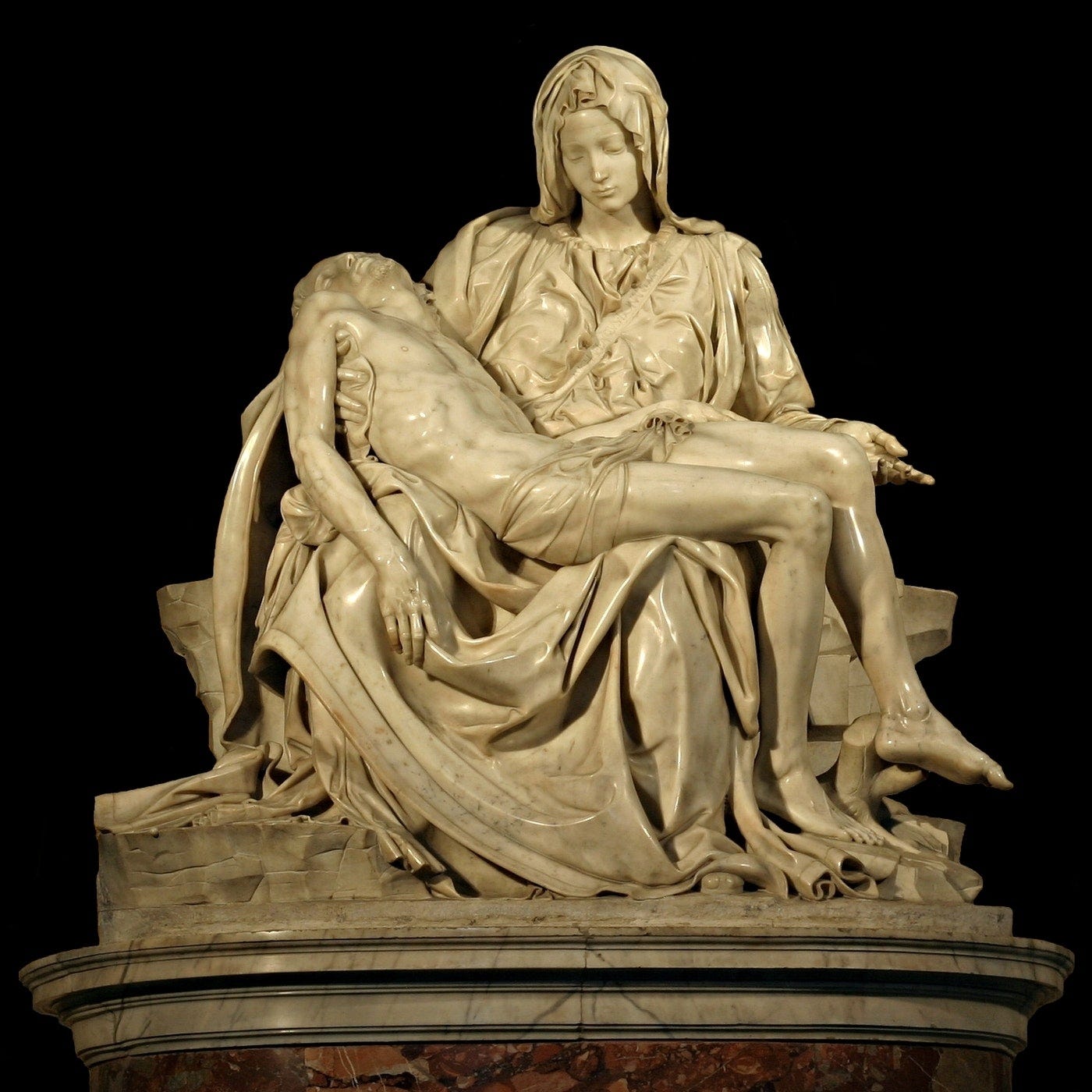
This is the loving touch of a mother who holds us as we weep.
I think it’s easier to understand, feel, and attune to Saturn if we imagine the planetary deity as the goddess of truth that matters. Her influence is gentle, opening, subtle, vast, and yet undeniable — much more akin to Venus and Luna than to Mars, Jupiter, or the Sun.
In fact, the ancient Hellenistic astrologers even named Saturn as one of the three Feminine planets.
And Qabalists identify the Sphere of Saturn (“Binah”) as the realm of the Divine Feminine, counterpart to Chokmah as the Divine Masculine.
(We can see this in the above Hermetic creation story: The One (Kether) ecstatically explodes into countless seeds (Chokmah), one of which enters time to grow in the womb of Form (Binah).)
So why did the ancient Greeks say that Chronos, god of time, is male? Where do we get this imagery of Grandfather Death from?
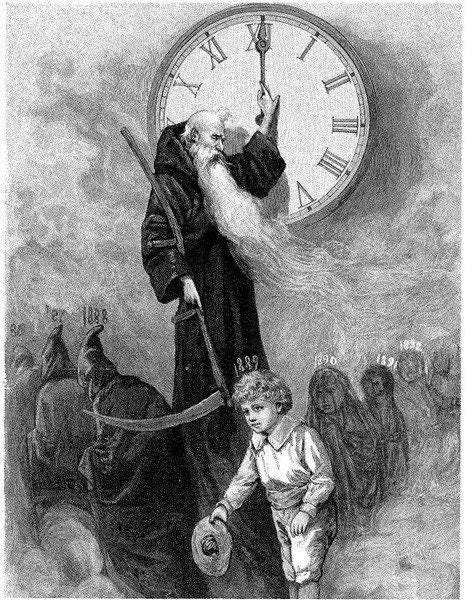
Well, in terms of history, I honestly don’t know.
But I have a guess.
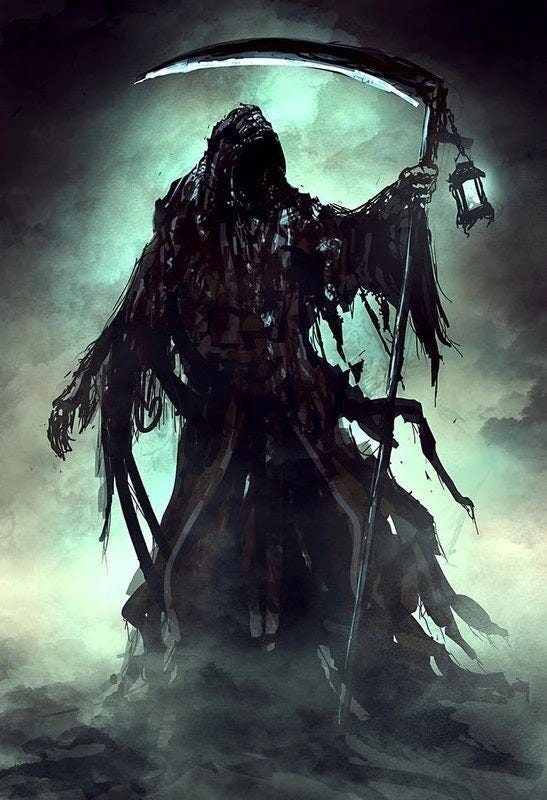
Most of the significations the ancients and Renaissance astrologers had for Saturn — old age, withering, sadness, failure, depression, self-doubt, senility, hopelessness, fatigue, diminishment, death — are the forms of Saturn’s influence that the ego most fears. They are how she gets your attention when the false self desperately tries not to notice.
Even the modern version — obligatory toil, responsibility, restriction, discipline, structure, mundanity — are all about the ego’s strategies for dealing with mortal terror: “How do I ward off Death? How do I earn safety?”
(This is actually an echo of the Protestant fear of and response to God’s judgment: “If I don’t work hard enough, or if I take pride in my work, God will send me to Hell!” Same origin as the Protestant work ethic.)
So I think the attempts to describe Saturn have mostly been the ego expressing its own recoil from her.
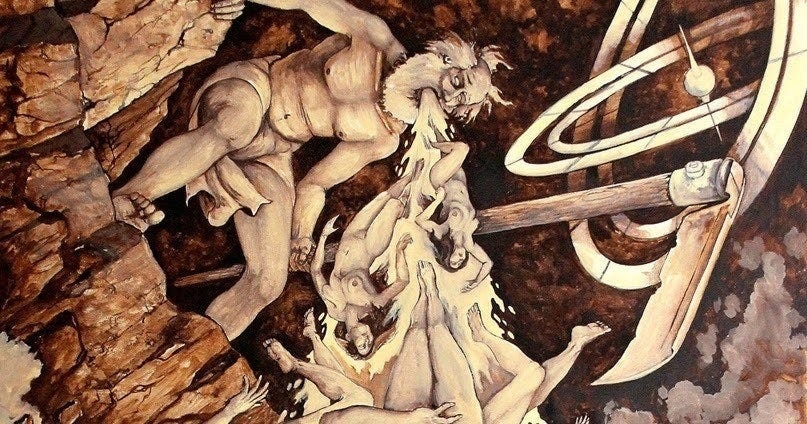
In other words, Saturn depicted as an old, withered man…
…was actually a reflection of what those male scholars feared they would one day see in the mirror!
They focused on their own egoic fear and recoil to avoid looking directly into the eyes of the Dark Feminine.
But she is patient, and understanding. She simply smiles and gently replies:
Go willingly or be dragged. Your choice, love.
When we focus instead on the blessings of Saturnine influence, we get a very different picture from the sweat-drenched ravings and hand-wringing of the terrified Masculine ego:
Maturity and wisdom
Clarity of perspective
Accepting needed rest
Deepening trust in existence
Letting go
Effortless living
Embodying and speaking truth freely
Releasing old, painful ways of being
Treasuring what matters most
Vulnerability and authenticity
Freedom from delusion
Fully accepting and working with what is real
Freely surrendering to the unknown
Spiritual awakening
Non-attachment
Serenity
These are most certainly not qualities to fear.
They just come with a price:
To receive these, we must let the truth in.
The parts of us that are made of lies and ignorance find this terrifying. They recognize that this would mean their end.
This is why Saturn is called “malefic” along with Mars. These two love and support us in our journey just as much as the rest. They just do so in ways that are challenging for the mortal to understand as good.
(…although that challenge is exactly part of how they support us!)
And the fact that Saturn’s “hard to understand” influences are Feminine is precisely why she’s known as “the Greater Malefic”.
It’s worth remembering that during most of human history women were revered and sometimes even worshipped as the portals between the material and spiritual realms. They bring souls into the world — through the same portal that can suck the vitality right out of a man’s cock and being in lovemaking. In a spiritually well-held container, women who are giving birth often go into a natural psychedelic trance purely by the power of their own bodies; this has led some cultures to view mothers as powerful shamans who successfully reached into the stars and brought their children safely to Mother Earth.
A tremendous amount of misogyny — not just hatred and oppression of women, but of the Feminine — has its roots in male mortal terror of this awe-inspiring power over the gates of life and death. As men and women both internalized this Masculine distrust of the wet and potent Unknown, men even started taking over the processes of birth (as doctors) and death (as priests), and they began ushering women in states of too much spiritual power (such as during menstruation or childbirth) out of their fragile holy places.
So it strikes me as utterly unsurprising that Mother Time…
…who took our soul-seeds from the stars into herself and birthed us into Form…
…would come to be depicted as a male figure…
…who, despite it all, even in ancient Greek myths still gave birth to the Olympian gods.
In Lon Milo DuQuette’s book “Understanding Aleister Crowley’s Thoth Tarot“, he explains the alchemical meaning of the four court cards of each suit. He calls it an “alchemical drama”. The highlights go something like this:
The King and Queen make love, making her pregnant.
The Queen gives birth to twins — a Prince and a Princess.
In the act of birth, the Princess totally loses touch with the monarchs, falling well beyond their direct reach.
The Prince leaves home to listen for word of the Princess and guide her home again, remaining in distant but direct contact with their parents.
He cannot fetch her from where she is without losing his connection to home. So she must reach out to him herself.
Once together, the Prince and Princess marry. (Yes, this seems a little odd. We’ll get to this.)
And upon their return, they become the King and Queen.
(Bear in mind that the names of the roles differ between decks. The Thoth Tarot calls the King “Knight”, whereas many other decks call the Prince “Knight” and the Princess “Page”. And modern playing cards call the Princess “Jack” and drop the Prince entirely! I’ll stick with the King/Queen/Prince/Princess language here.)
The Princess is us, so to speak. The human mortal. And the Prince is the Holy Guardian Angel, a.k.a. the Higher Self. We call their union at the end “the Alchemical Marriage”, the fusion of Heaven and Earth.
But what are we to make of the King and Queen? Who or what is it that we become after the Alchemical Marriage? That is, what does it mean for the mortal to “become the Queen”?
To answer that, it’s helpful to connect this alchemical tale with the earlier creation story. That story follows what’s called “the Lightning Flash of Creation” on the Qabalistic Tree of Life:
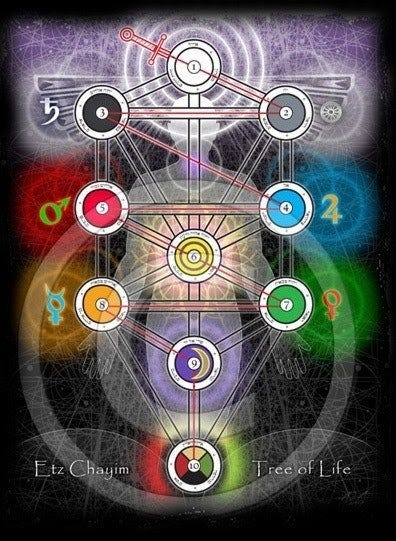
The King is the multiplicity of Chokmah, who ecstatically explodes into countless star-seeds. That’s the gray circle in the upper right.
The Queen, at Binah, is Saturn. The story of the twins’ birth is describing the process of one of those seeds entering time. (We’ll get to how one seed becomes “twins” later.) Her Sphere is the black one at the top left.
The Prince (a) goes as far down on the Lightning Flash as he can while (b) still staying in contact with the Eternal realm of the top three Spheres via direct Paths. That farthest point is the Sphere of the Sun (“Tiphareth”), the middlemost yellow circle. If he were to go any farther, he would forget Eternity and would not be able to bring the Princess home. So there he waits.
And the Princess falls aaaaall the way to the bottom, to the Sphere of Earth (“Malkuth”). There, not only is she out of sight of Eternity, but all three adjacent realms (the Spheres of Luna, Mercury, & Venus) also fail to connect directly to the upmost triad. And Earth has no direct link to the Sun, where her Prince resides.
Because of all this, the Princess must travel up the Tree if she’s to reunite with her family — which is to say, to remember who she is.
The Princess’s first step up the Tree is the reverse of her last step down: She journeys up to the Sphere of Luna — the subtle realm of energies, archetypes, and the subconscious — along that lowest vertical Path.
That Path between the Earth and the Moon is unique. Every Path on the Tree has a corresponding major arcana tarot card, and every major arcana card is the trump of a planet, zodiac sign, or element. But that key Path, the Path of the card “The Universe”, is the only one with two significations:
It’s the elemental trump of Earth…
…and also the planetary trump of Saturn.
We see this curious duality between Gaia and Saturn appearing in metallurgic alchemy too. The task of turning lead into gold, in pursuit of riches and immortality, reflects the journey from Malkuth (Earth) to Tiphareth (the Sun). But lead isn’t really the metal of Earth the way gold is the Sun’s. Lead is specifically the metal of Saturn. So somehow lead is standing in for Malkuth — which is to say, alchemy uses Saturn to indicate the Earth.
This echoes a common Qabalistic saying: “Kether is in Malkuth.” Because the top three Spheres reside beyond time, they are paradoxically both different and the same. Since Binah (Saturn’s Sphere) is the entrance to time, it’s the closest of the three to being something like comprehensible to mortal minds, so it’s common to use its symbols to stand in for the whole upper triad.
So a slightly more astrologically flavored way of expressing this Qabalistic saying is: “Saturn dwells on Earth.”
Which leads us right back to this curious matter of the Earth-bound Princess becoming the Saturnine Queen.
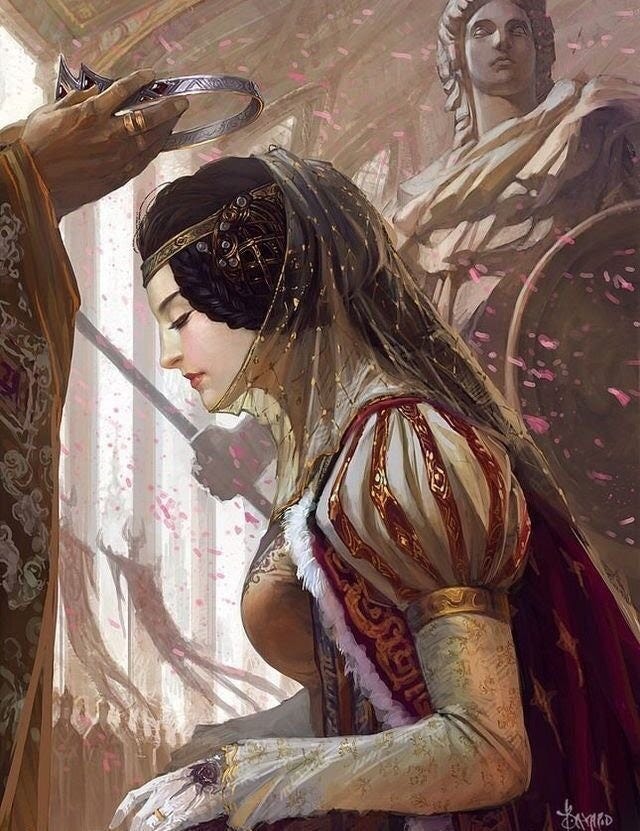
The word “becoming” is a bit deceptive here. It’s more like remembering — in exactly the way Saturn governs aletheia, i.e., truth as un-forgetting. After their union in the Alchemical Marriage, the Prince and Princess remember that they always were the King and Queen.
Yes, in a curious way, they are their own parents — just as they are secretly aspects of one another.
In order for our soul-spark to fall below the Sphere of the Sun (“Tiphareth”) the first time, we had to forget Eternity. But this is quite a trick because there isn’t anything other than the Eternal. (“In the beginning, all is One.”) So that step down from the Sun is a matter of creating distance from, and learning to ignore, the parts of us that recognize the ever-present Now.
We call those intentionally forgotten parts “the Holy Guardian Angel”.
And climbing back up to Tiphareth is the same thing as remembering and reclaiming those parts of ourselves.
In my experience, meeting the Angel at Tiphareth doesn’t really feel like talking to a separate spirit or guide. That’s just how it looks from the lower four Spheres while climbing up. Rather, “meeting” my HGA in the Sphere of the Sun feels more like:
“Oh. Right. I am the Angel. I have a mortal form. And I always knew that. Right.”
Having gone through the fall-and-climb, though, the experience has changed. In a non-mental way, I can remember the descent, and I see how this new experience of the Sun is different. I have a body now. I know what it’s like to turn my gaze away from Eternity and live purely within time. I understand suffering, and mercy, and why they matter.
And I un-forget why I did all this in the first place — including the forgetting.
Taking the throne after this is a matter of having one foot in time and the other in Eternity. Fully incarnate, fully God. Straddling the paradoxical dance of remembering and forgetting, and giving birth to a blissful world.
Which is to say, coronation is a matter of remembering that you are Saturn.
You bring yourself into time.
Climbing back up to the upper three Spheres is the same thing as remembering that you never left — just as meeting with your Angel is a matter of realizing that you two have always been one and were never apart.
As Saturn, as quite literally truth incarnate, you choose how much of this you will un-forget, and when.
You didn’t really have a chat with some planetary deity before you were born to plan out the flow of time in your life. That’s just how it looks “in retrospect” while you forget.
Rather, you are having that “conversation” with yourself, right in this very moment.
You experience that “discussion” as the apparent flow of time from one moment to the next.
This is that life-planning exploration with the Dark One.
Right here.
Right now.
At once beyond and within time.
For otherwise you would not be reading this…
…Your Majesty.

Most of the above came from Saturn teaching me directly. I attuned to her frequency, and she guided my attention.
I didn’t recognize her as Saturn at first, really. It wasn’t until I started trying to make sense of natal charts that I noticed that this Dark Feminine energy fits so, so well in the role of the Greater Malefic.
(Although I had noticed hints before — namely that Hellenistic astrologers call Saturn “feminine” and that the Sphere of Saturn is that of the Divine Feminine.)
For a while I tried using the modern “disciplinarian” vibe for Saturn anyway. It’s a coherent energy signature. I tried to see how those two are secretly the same, or how they both applied in folks’ charts.
But after a while I gave up trying to reconcile them.
The Goddess of Truth just… fits there.
Reading natal charts that way makes the whole chart light up for the other person. Their soul remembers.
So I just found myself awkwardly disagreeing with astrologers about their own art!
Alas.
And then, after leaning in that direction for a while, I found out that this vision of Saturn is way closer to historically accurate.
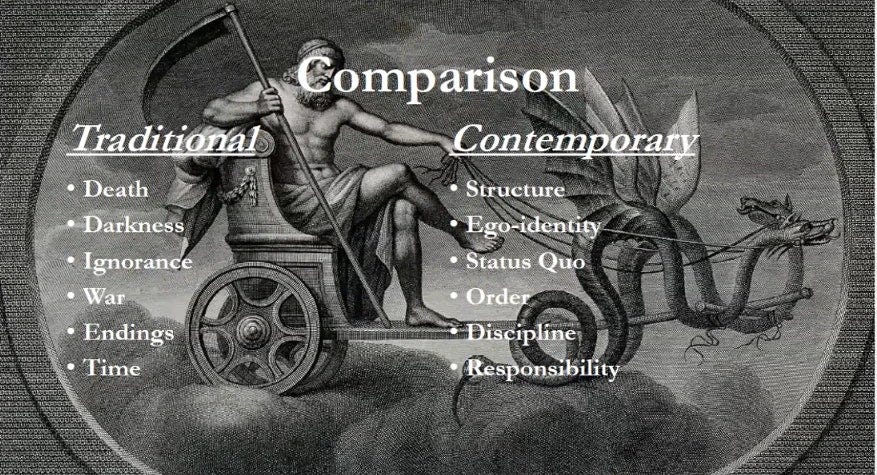
Matthew Merlin gave a talk he called “Resurrecting the God of Death” in which he spelled out the history of Saturn’s significations. It turns out that what I’ve named here is much closer to traditional ways of describing Saturn than is the modern “discipline/structure/obligation/etc.” vibe.
(The above image is a slide from his talk.)
Merlin really does his research. He even learned ancient languages so he could read the actual original untranslated texts himself!
I’m definitely not going to do his research justice here. But I’d like to offer my attempt at a few main highlights and conclusions that stood out for me.
It turns out that around the turn of the 20th century, some astrologers started dropping Saturn’s “death and decay” connotations and added the now-familiar “structure” meaning. If I remember right, Merlin couldn’t quite pinpoint why. My best guess is that this was due to the upsurge in “positive thinking” coming from e.g. New Thought: “Focus on the positive to manifest the positive! Give the negative no attention lest it come about!”
(This later gave rise to “Think and Grow Rich” type philosophies and, now, the popular version of the “Law of Attraction”.)
Then in 1930, astronomers identified and named Pluto. Astrologers reasoned that whatever caused the scientists to christen it the Roman god of the underworld must have been meaningful, so they guessed that the planet must have something to do with death and transformation — which were influences that had been achingly missing in astrological readings for over a quarter century at that point. So Pluto got some of Saturn’s old significations.
So if you’ve been reading through this and thinking “Hey, isn’t he actually describing something like Plutonian energy?”…
…well, that’s why!
I didn’t set out to challenge how modern astrologers do what they do. If you work with Pluto and you view Saturn as the structure guy and you get good results, great! You do you.
I just found it immensely remarkable that I didn’t know any of this… and Saturn taught me. Saturn corrected my impressions.
And then history corroborated her lessons to me.
That seems remarkable enough to be worth sharing.
When someone’s next step in their fate dance is to attune to Saturn, I focus on reminding them:
You already know how to do this. You know her voice. Just be still, and listen.
It’s very easy to get into the culture’s trappings and ego distractions. “Death is a great teacher!” “I got this great black candle and some myrrh and some sombre music ready to go.” “Oh yeah, I looooove looking at dead birds, seeing their decay….” “Right, I’ve gotta meditate.”
These are all perfectly fine.
And they’re also loud.
If you want to hear her, you know the silent note to listen to.
Think of a loved one. What if something were to happen to them before you see them again? The last time you looked them in the eye might be the final time.
Do you remember how you parted? How you felt? The quality of your attention to that last moment?
What does being still with that truth stir in you?
Breathe. In this moment. This precious moment.
Nearly everyone has something to grieve.
You matter.
Your sorrow matters.
You know where I’m pointing.
Whenever you’re ready.