


Welcome to Relentless Dawn!

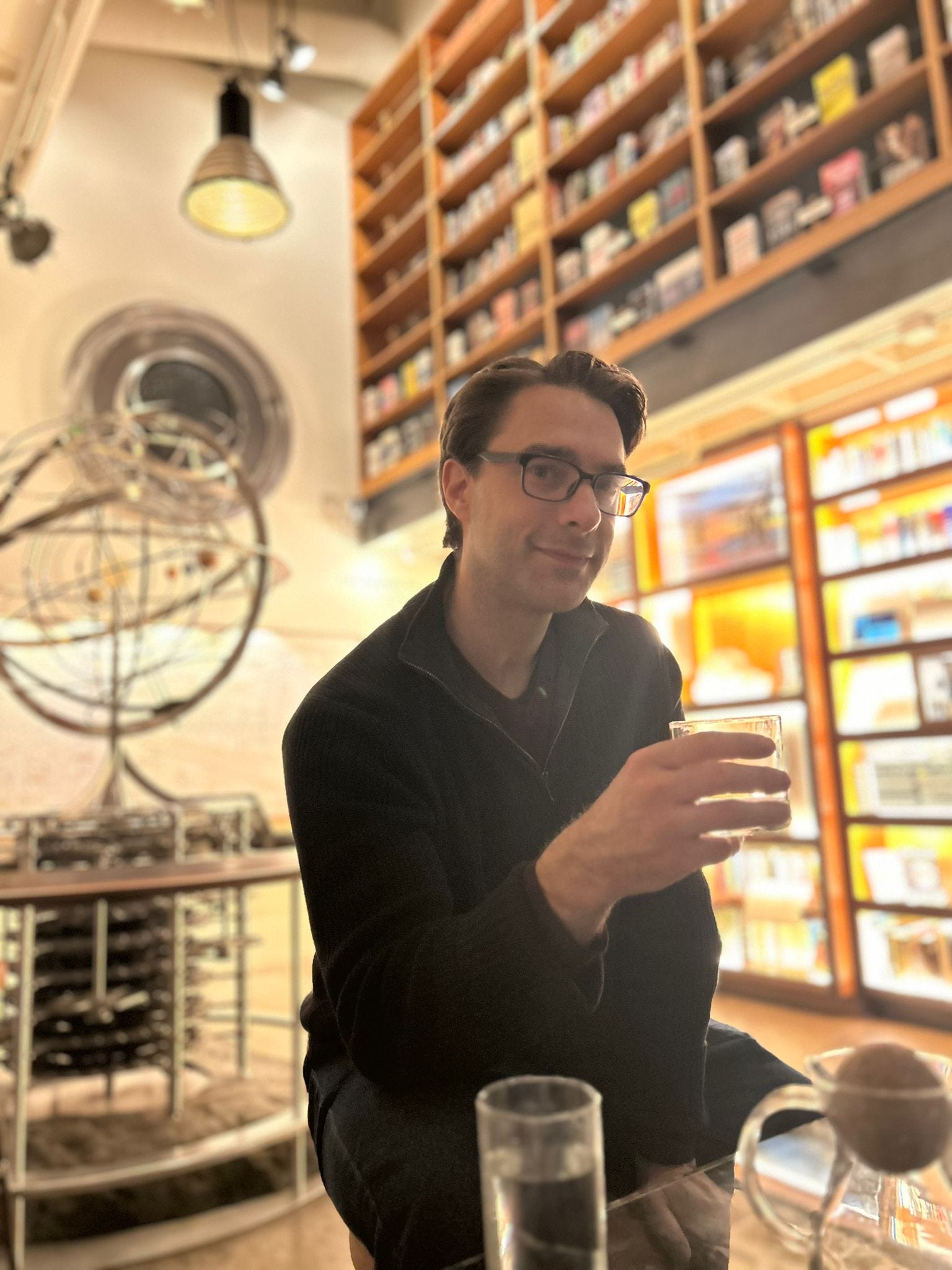
My name is Michael Smith. Many folk know me as “Valentine”. You’ll find me as “Morphenius” across the web (but mostly here or on Twitter/X).
The name “Relentless Dawn” captures several elements I find beautiful and meaningful. I grew up with a very hopeful and life-affirming version of transhumanism (the view that we can and will grow well beyond our current limitations as humans, possibly within our lifetimes). Humanity might be foolish in lots of ways in its youth, but it sort of inevitably conquers the challenges that face it. Sometimes with enormous effort! But it happens, and we kind of can’t help ourselves.
It’s also a nod to the dawn depicted in C.S. Lewis’s The Great Divorce. If you haven’t read it… well, these days you can just ask AI to tell you what I’m referring to. But I recommend you don’t. That’d be a bit like asking an AI to summarize Edgar Allen Poe’s The Raven. Lewis conveys something that’s meant to impact you, and the story and ideas he uses to give the dawn context matter for that impact. Best to leave it as a bit of a mystery, and perhaps read the short story on your own sometime. It’s really quite quick.
(It’s also quite Christian. Just to be clear, I don’t identify as Christian. But I don’t shy away from theology either. I trust that there’s something meaningful people are trying to grapple with in religion, even if they don’t know how to name it clearly, even to themselves.)
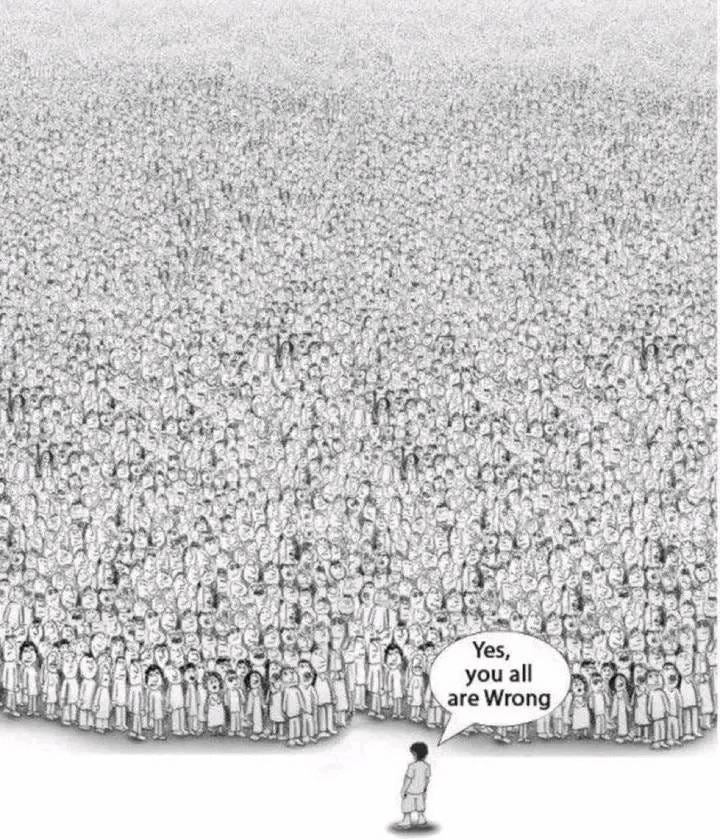
Exactly how I talk about the “relentless dawn” varies a fair bit. If I had to pick a single underlying theme, I’d name gnosis: the intimate and unalienable knowing that’s deeply a part of you. In meaning (and in etymology), it’s closest to the now-forgotten English verb “ken”, which is the way in which we know a person or how a master of an art knows their craft. (“I ken him well.”) It’s a kind of familiarity rather than consciously knowing information. But gnosis is also a particular kind of familiarity: you might be familiar with the Pythagorean theorem as a fact and how to apply it as a procedure, but you’re probably not unshakably certain of it the way you are of 1+1=2. To have gnosis of the Pythagorean theorem, you would need to ken the reasons why it must be true, and when. Gnosis is the kind of knowing that makes the move in the following image feel easy, even if it’s still socially terrifying or strategically unwise:
More concretely, here are some topics I’ve talked about:
Memetics. If biology is the study of self-replicating & self-repairing patterns of matter, then memetics is the study of self-replicating & self-repairing patterns of behavior. My guess is, awareness of memetics will be at least as big as literacy for what humanity becomes. You can read a short intro to the idea here.
Psychic structures. People are organized in particular ways inside. How they’re organized determines what reality looks like to them. Pointing out these structures can cause some of them to change. That process can be extremely psychoactive! I love this topic and also think it’s extremely useful. Maybe my most vivid example in this category is my essay on the hostile telepaths problem.
Math as gnosis play. My Ph.D. is in mathematics education. It’s my opinion that most folk are never taught math. They’re mostly taught computation and obedience, usually in ways that are antithetical to what’s really noble about the discipline. Math, in its most beautiful and glorious form, is a playground for developing gnosis of truth. I talk directly about math in this light here, but many people prefer my essay on more general teaching and learning philosophy (derived from the same ideas) here.
Hermeticism. I love Western culture, and I love that it has some semi-hidden influences. One of them shows up as the fantasy genre in fiction, and the popularity of Harry Potter, and the weird way modern spirituality gets tied up with stuff like astrology and numerology. I also think there’s a sane & lovely way of exploring this stuff without getting too confused. I sort of separate out this topic; you can view the magic section’s intro here.
Death. I think it’s important. I don’t see culture orienting to it very clearly. It breaks my heart. I talk about my unusual angle on death in several posts here.
If topics like these ones appeal to you, consider subscribing:
Sometimes — especially in the “magic” section — I’ll reserve some things for paying subscribers. But the lion’s share of what I want to talk about is free. I like writing and I like encouraging discussion.
I try to be pretty approachable. Please feel free to reach out, comment, bring your thoughts, let me know how my work is landing for you.
Welcome!
